Articles · Walking tour
Walking the Berlin Wall Escape Routes: A Self-Guided Tour
Two walks and two short add-ons, built from the dated escapes on this site. Each stop says what happened within a few hundred metres, what you can still see there, and how far it is to the next one.
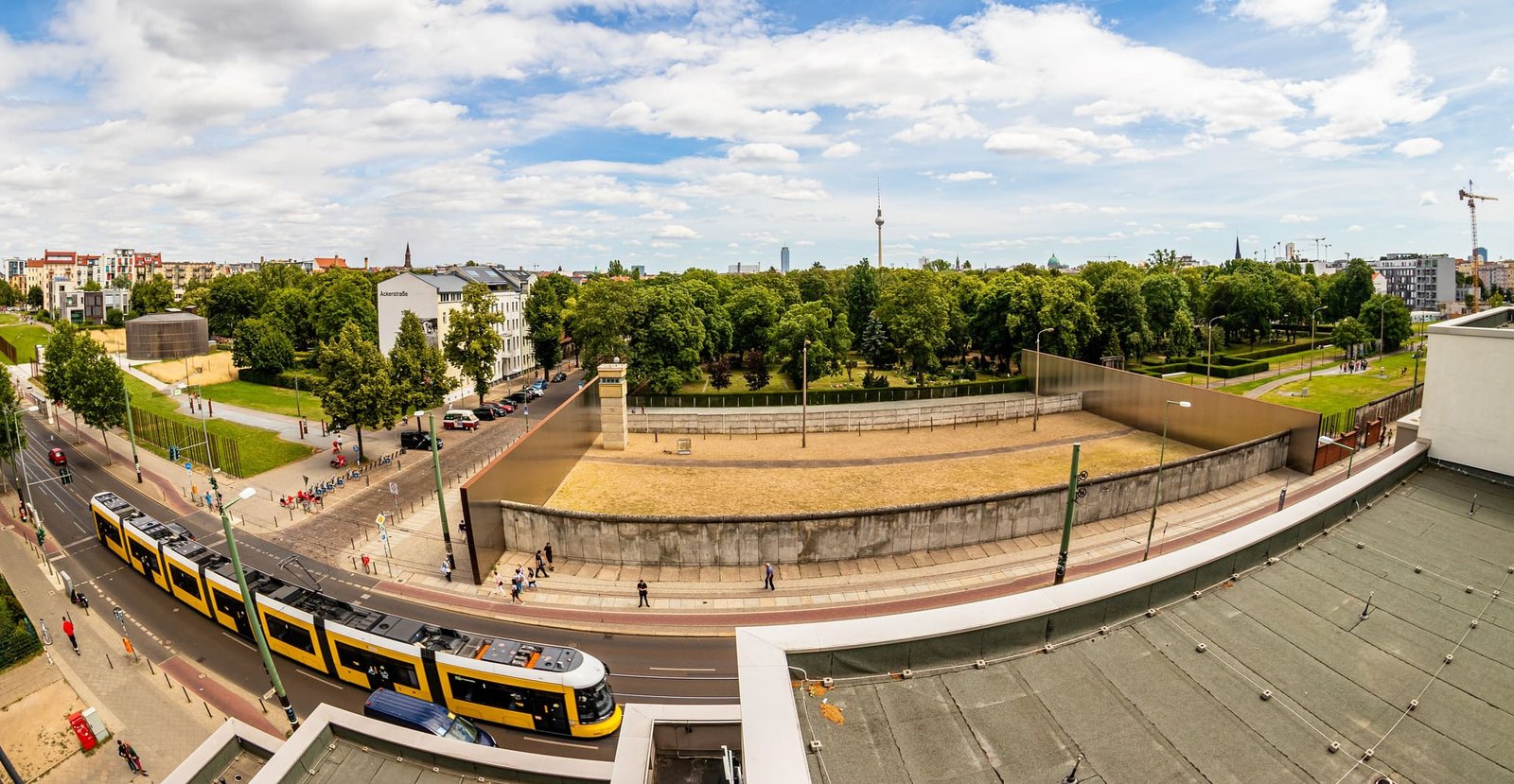
Walk along Bernauer Straße through the memorial grounds and look down. Between Nordbahnhof and Schwedter Straße, more than 140 small metal markers are set into the ground, each recording something that happened on that exact spot.2 Between here and Mauerpark, this site has dated records of people who slid down ropes from bricked-up flats, drove lorries through the wire, crawled through tunnels from cellars and jumped the barbed wire in uniform.
This walk links those records to the ground. Every stop names the escapes that happened within a few hundred metres, says what is there to see today, and gives the distance to the next stop. A second route follows the Spree to Heidelberger Straße.
Before you go
- Route 1, Bernauer Straße: about 2.8 km, roughly 37 minutes of walking; allow 2–3 hours. Start at S Nordbahnhof (S1, S2, S25, S26), finish at U Eberswalder Straße (U2). U8 Bernauer Straße is a mid-route exit.
- Route 2, the Spree and Heidelberger Straße: about 5.5 km, roughly 74 minutes of walking; allow 2.5–3 hours. Start at S+U Warschauer Straße, finish at S Treptower Park.
- Add-on A, Checkpoint Charlie: about 1.8 km, 24 minutes, Potsdamer Platz to Zimmerstraße.
- Add-on B, the canal: about 2.9 km, 39 minutes, U6 Naturkundemuseum to Berlin Hauptbahnhof.
Distances are straight lines between stops multiplied by 1.3 to allow for street corners, at a walking pace of 4.5 km/h. Treat every time as approximate.
The Berlin Wall Memorial's outdoor exhibition on Bernauer Straße is open every day from 8 a.m. to 10 p.m. The Visitor Centre (Bernauer Straße 119) and the Documentation Centre (Bernauer Straße 111) open Tuesday to Sunday, 10 a.m. to 6 p.m., and admission is free.1 Before you set off, open the Foundation's Digital Guide on your phone: it maps the event markers in the ground and is in English and German.2
- Reached the West
- Some got through
- Stopped
- Killed
- Window jumps5243 reached the West · 2 some got through · 3 stopped · 4 killed
- Over the wall3617 reached the West · 1 some got through · 17 stopped · 1 killed
- Guards who fled1110 reached the West · 1 some got through
- Tunnels92 reached the West · 1 some got through · 6 stopped
- Driving through32 reached the West · 1 stopped
- False papers and disguises32 reached the West · 1 stopped
Along Bernauer Straße, window jumps and climbs from 1961 dominate, with the big tunnels in between. All the records are on the Bernauer Straße place page.
Route 1: Bernauer Straße
- Visitor Centre, Bernauer Straße 119
- Documentation Centre and tower, Ackerstraße corner
- Chapel of Reconciliation
- Tunnel 57 plates, Strelitzer Straße 55 and Bernauer Straße 97
- Brunnenstraße corner, U8 Bernauer Straße
- Tunnel 29, Schönholzer Straße 7
- Conrad Schumann's jump, Ruppiner Straße corner
- Bernauer Straße 44–48 and Kremmener Straße 15
- Oderberger Straße / Mauerpark edge
Stop 1: Nordbahnhof and the Visitor Centre
Getting there: from S Nordbahnhof, about 340 m, 5 minutes.
While you are in the station, look at the exhibition "Border and Ghost Stations in Divided Berlin", open whenever the station is.1
What happened here: the Sophien cemetery ran right up to the border strip, and its wall was used as cover. Dog handler Werner K. slipped away over the cemetery wall in October 1961 while training his successor. Helmut P. got over in June 1962 while two guards fired at him, and Peter St. crossed on his birthday in May 1966, leaving his wallet and call-up papers behind. On 4 September 1962 Ernst Mundt was shot on the same wall; his story is on Victims of the Wall.
What you see today: the start of the memorial's outdoor exhibition, with the first of the metal event markers underfoot.
Stop 2: Documentation Centre and tower, Ackerstraße corner
Getting there: about 290 m, 4 minutes.
What you see today: climb the tower at the Documentation Centre (last entry 5:45 p.m.) for the view over the preserved border strip.1
What happened here: the houses on the south side of Bernauer Straße were in East Berlin, but their front doors opened onto a West Berlin pavement. A few weeks after 13 August 1961 they were cleared and their doors and windows bricked up. Until then, residents slid down ropes or jumped into the nets of the West Berlin fire brigade.9
At Bernauer Straße 2 a woman jumped from the first floor on 26 August 1961, and four nights later eight people got out of the same house in two groups. At Ackerstraße 43, on the corner, West Berlin police dazzled the guards with mirrors while the fire brigade put up a ladder for Karl-Heinz S. and three others. In October, two men crossed the roofs with a washing line to reach the same corner house.
On 13 August 1961 itself, a VW Beetle drove through the single roll of barbed wire across Ackerstraße. Not every descent ended well: Rudolf Urban was badly hurt roping down from Bernauer Straße 1 and died weeks later.
Stop 3: Chapel of Reconciliation
Getting there: about 220 m, 3 minutes.
What happened here: on the night the border closed, a radio singer and her son crept through back yards and a cemetery to the Reconciliation Church, whose gate to the West was still open. Along this row, the houses emptied one family at a time: the Mathern family left their ground-floor flat at no. 11 on 17 August; parents and their 14-year-old daughter roped down from no. 10; and at no. 8 the heavily pregnant Helga Knittel jumped first into the fire brigade's net, followed by her daughter and husband.
Later the church grounds became part of the strip. In July 1968 Bernd B. crawled to within five metres of the Wall in its shelter before he was shot.
What you see today: the Chapel of Reconciliation, on the site of the church. The memorial's Window of Remembrance, and the people who died at the Wall, are covered in the Victims of the Wall guide to memorials.
Stop 4: Tunnel 57
Getting there: about 200 m, 3 minutes.
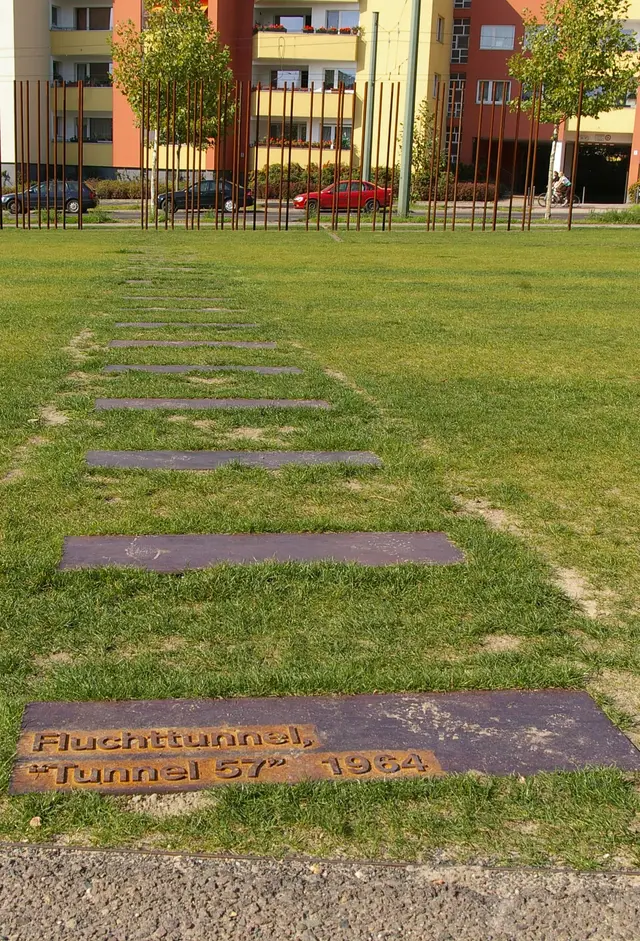
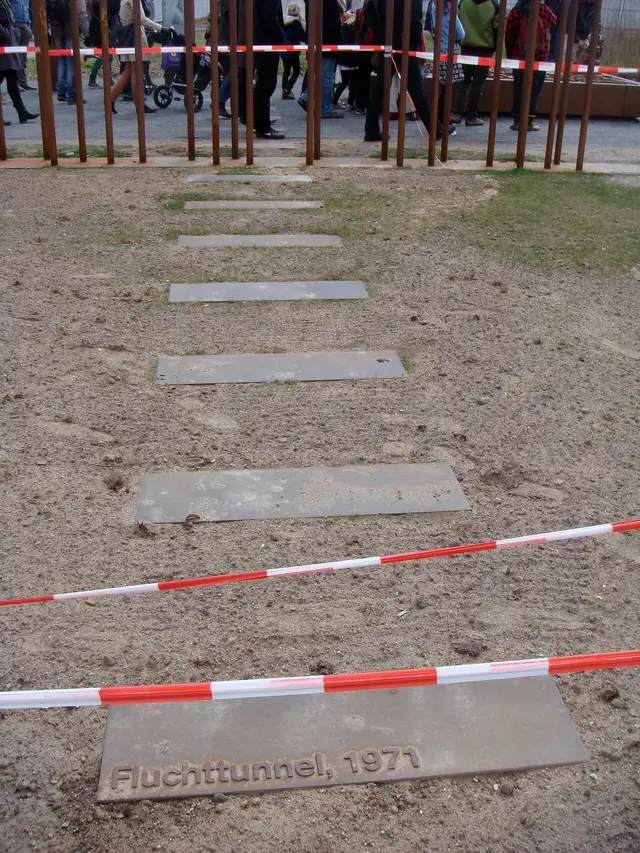
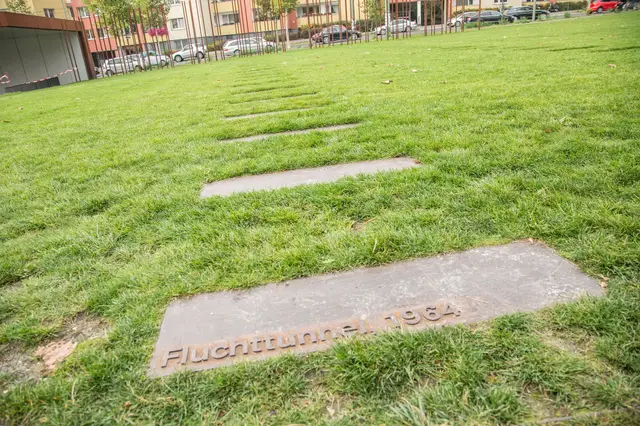
What you see today: at least ten escape tunnels were dug under Bernauer Straße between 1962 and 1971, but only three were used successfully. The steel plates in the lawn trace two of them, both used in 1964 and both dug from a bakery at Bernauer Straße 97.3 Cross the road to no. 97: the plaque to the diggers hangs on the right-hand wall of the entrance passage, barely visible from the street, and was unveiled on 2 October 2011.6 Back on the eastern side, a plaque at Strelitzer Straße 55 was unveiled on 4 October 2004, on the initiative of two former helpers, Peter Schulenburg and Klaus von Keussler.5
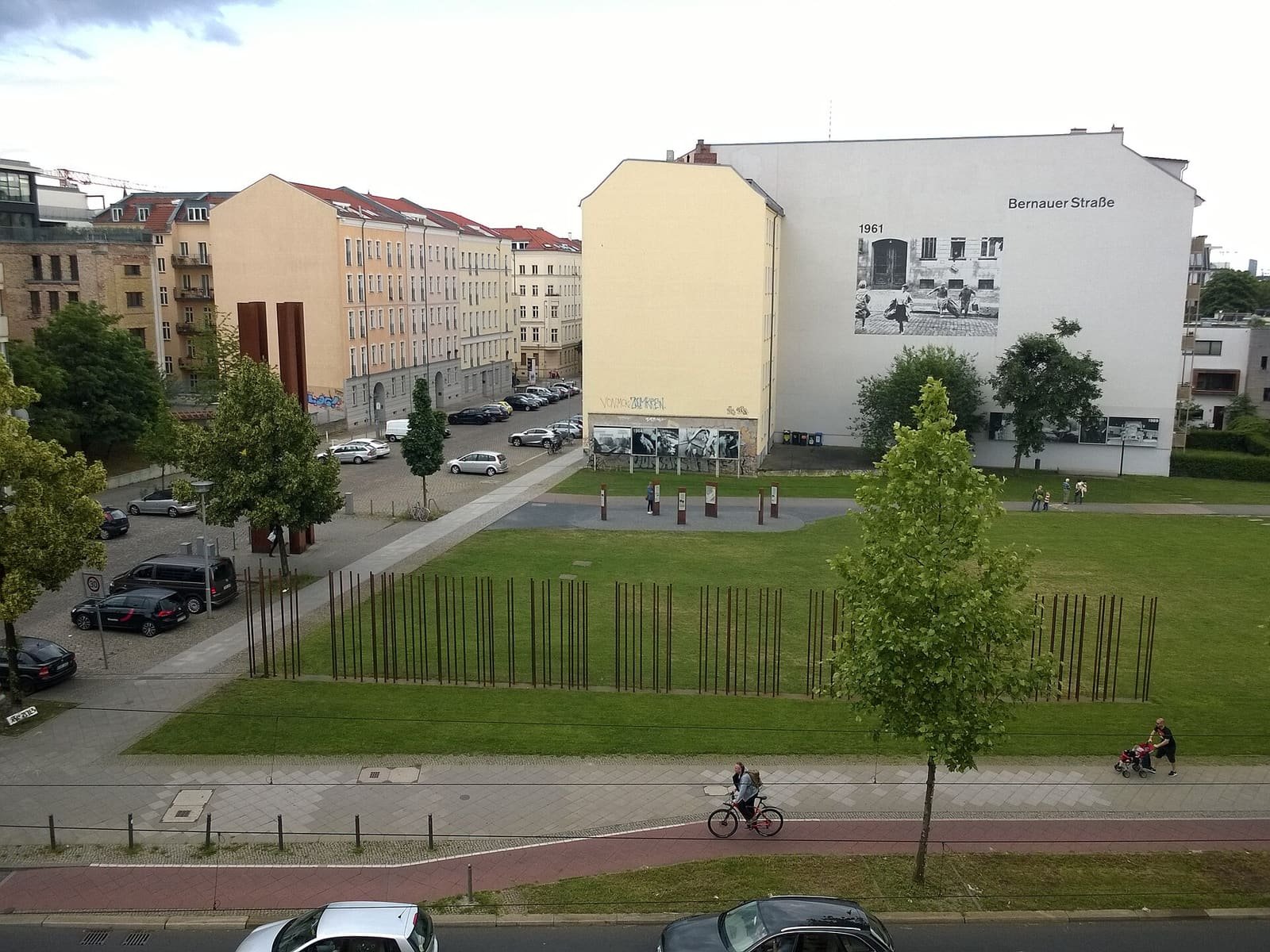
What happened here: the first tunnel from no. 97 came up in a coal yard in January 1964; three young women got through before it was found. The second, Tunnel 57, ran 145 m under the Wall at a depth of 12 m, and 57 people came through it on 3–4 October 1964.4 The plaque at no. 97 gives the depth as 10 m.6 The escape ended in a shoot-out in which the border guard Egon Schultz was killed; the record explains what files opened after 1990 showed.
Two more records sit on this corner: a transferred riot policeman who climbed the Wall behind a sight screen in December 1961, and a 22-year-old shot in the leg almost at the foot of the Wall in 1970.
Stop 5: Brunnenstraße and the tunnel you can enter
Getting there: about 220 m, 3 minutes. U8 Bernauer Straße is here if you want to stop.
What happened here: in the first days Brunnenstraße was a crossing point. On 14 August 1961 a doctor rode through with an ambulance and did not go back, and on the same day the waiter Peter Hohmann sprinted past the guards. Four days later two men in postal uniforms told the guards they had to check cables and cycled into the West.
The Wall here was still being crossed in the 1980s. An unknown man got over with a ladder in 1984 despite an aimed shot, and in 1986 the toolmaker Dieter H. crossed with a home-made folding ladder while twelve shots were fired at him.
What you see today, and below: in 1970–71 Hasso Herschel's team dug Tunnel 71 under Bernauer Straße and stopped about ten metres short when the border troops dug it up. Berliner Unterwelten's "Under the Berlin Wall" tour takes you into what it calls "the only original escape tunnel still visible under the Wall". It starts at Brunnenstraße 141 and lasts 90 minutes. Tickets are sold online only, it is not suitable for children under 7, and it is about 10 °C underground, so bring a layer.10
Stop 6: Tunnel 29
Getting there: about 240 m, 3 minutes.
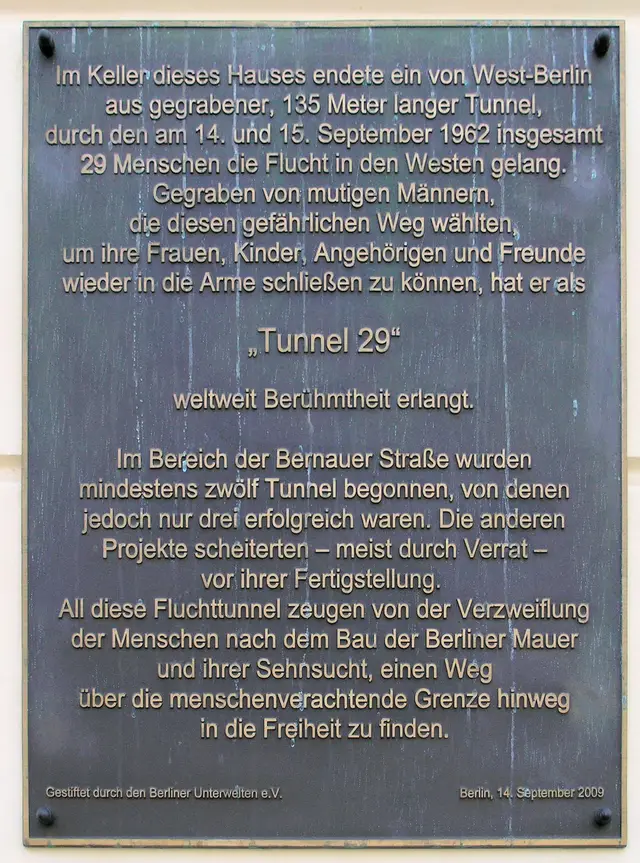
What you see today: an information panel on Bernauer Straße near no. 78, one of four between Schwedter and Strelitzer Straße, records that on 14 and 15 September 1962, 29 people fled to West Berlin with the help of a student escape-aid group.7 A plaque on the house wall at Schönholzer Straße 7 marks the eastern end, where the refugees climbed into the tunnel.
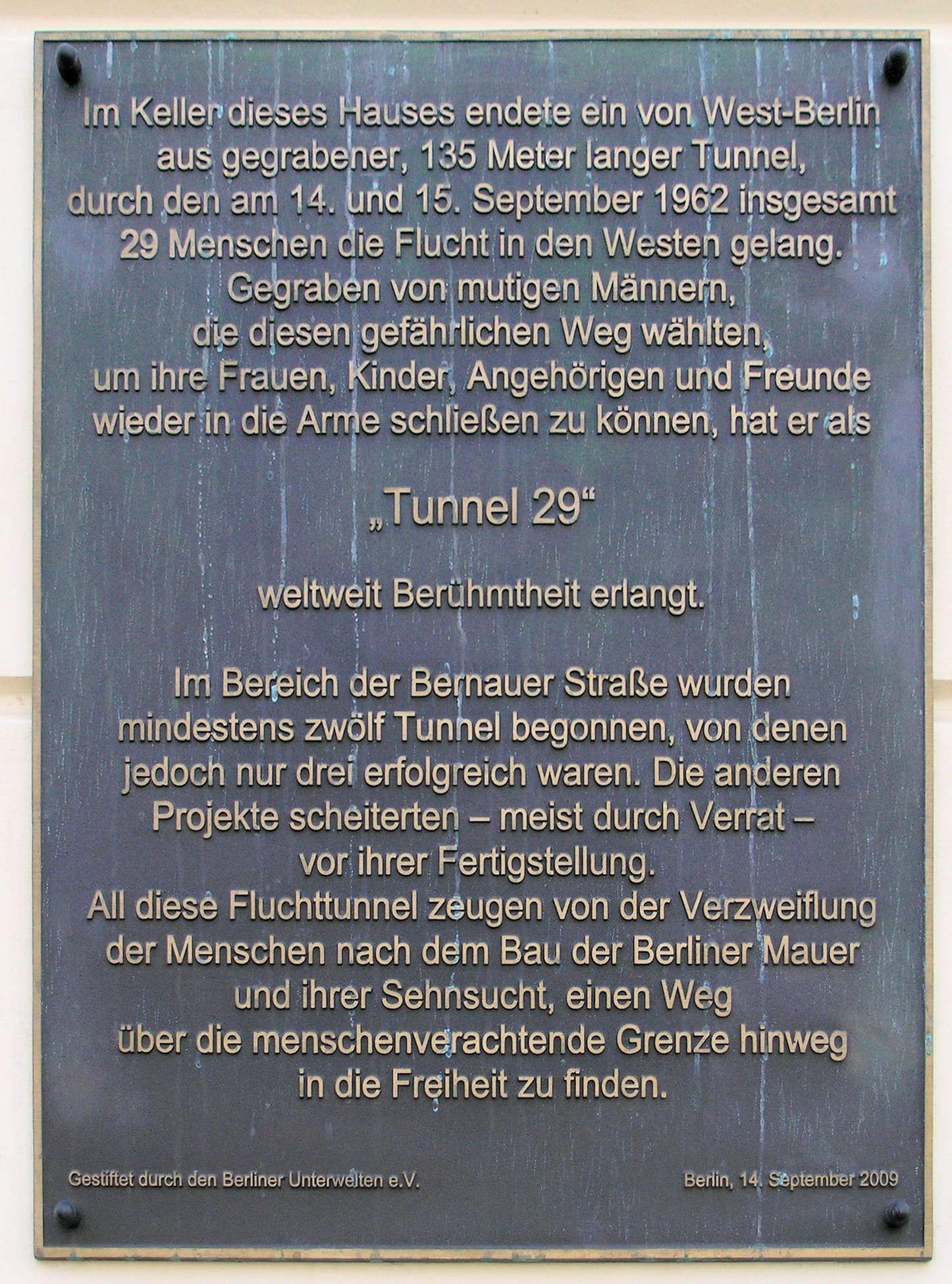
What happened here: Tunnel 29 ran from a factory on Bernauer Straße to a cellar in the East, and an American TV crew filmed the escape. Sources give its length as about 120 to 135 m; the record sets out who says what. From the same cellars the diggers tried again in 1963, but the second tunnel was betrayed: Stasi officers were waiting, and 14 would-be escapees and three couriers were arrested. In 1970 the Stasi dug up an 85-metre tunnel from Bernauer Straße 80.
Above ground, a man with a folding ladder crossed every barrier here in 1968 while the tower crew struggled with a window that would not open. Klaus N. was less lucky in 1966: fired on, he slipped back into East Berlin and was arrested.
Stop 7: Conrad Schumann's jump, Ruppiner Straße corner
Getting there: about 130 m, 2 minutes.
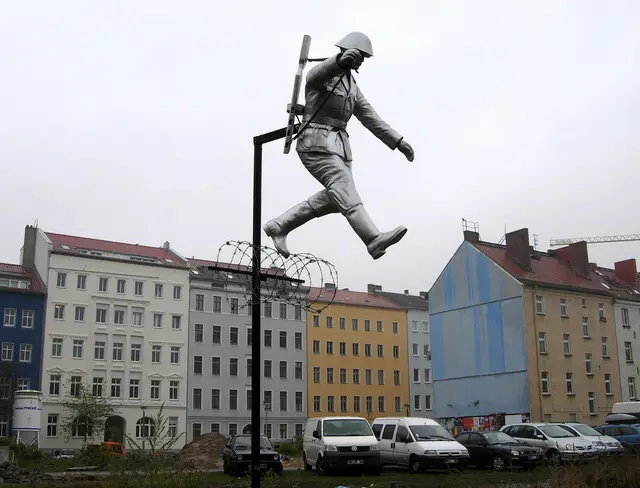
What you see today: a panel of the Berlin Wall History Mile stands at the corner of Ruppiner Straße, one of several along the street.7 It records that on 15 August 1961, two days after the Wall went up, the 19-year-old border guard Conrad Schumann jumped the barbed wire into West Berlin here.8 A sculpture of the jump stands on the former strip nearby.
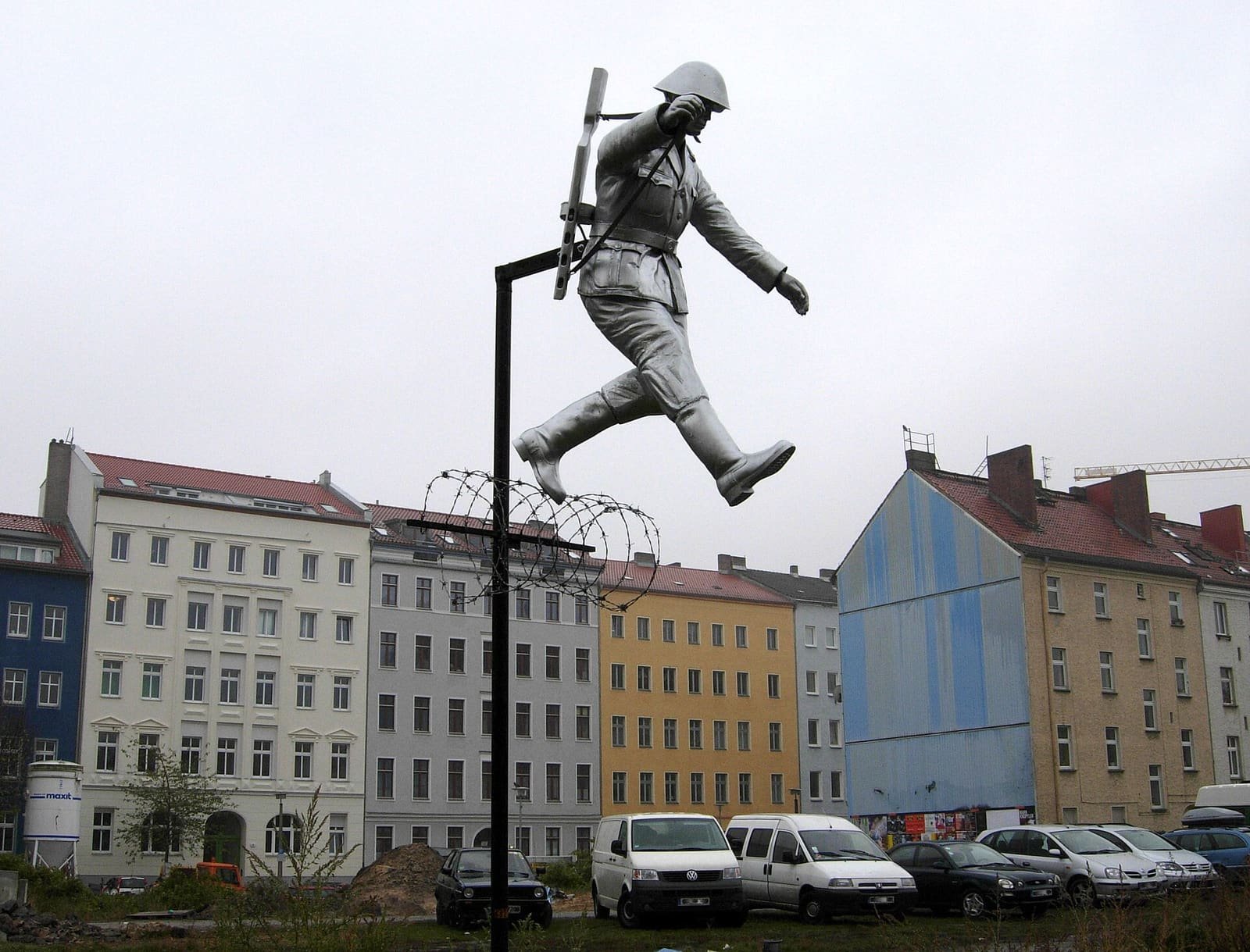
What happened here: the photo of Schumann's leap, dropping his submachine gun as he went, became one of the best-known photographs of the 20th century. Two days later, three young men drove a lorry through the barrier at the same corner. In January 1965 a man got over with a rope ladder under fire. And on 8 April 1989, seven months before the Wall opened, a heavy lorry smashed through both gates here but was caught in a cable barrier built to stop lorries.
For more guards who crossed, see border guards who escaped the Berlin Wall.
Stop 8: Bernauer Straße 44–48 and Kremmener Straße 15
Getting there: about 430 m, 6 minutes.
What happened here: between the Swinemünder and Wolliner Straße corners, the window escapes of 1961 continued. A married couple climbed out at the Wolliner Straße corner on 20 August. An unknown man let himself down on a telephone cable from no. 47. The electricity worker Peter Hertel got into a border house with a forged order to remove meters, climbed out of a third-floor window, found his rope ended at the first floor and finished on a gas worker's ladder. The bricklayer Norbert Raasch was sent to brick up the windows of no. 44 and jumped from one of them.
This is also where Ida Siekmann jumped from Bernauer Straße 48 on 22 August 1961 and died, the first known death at the Wall.9 A Wall History Mile panel stands near no. 48.7 Her story, and those of others who died on this street, is told on Victims of the Wall.
Turn briefly into Kremmener Straße. From a disused bakery cellar at no. 15, East Berliners dug a 45-metre tunnel towards the West; it was discovered in May 1963 and 19 people were jailed. A plaque marks the house.
Stop 9: Oderberger Straße and the end at Eberswalder Straße
Getting there: about 150 m, 2 minutes, then about 550 m, 7 minutes to the U-Bahn.
What happened here: a tunnel from the old freight yard, where Mauerpark is now, was aimed at the corner house of Eberswalder and Oderberger Straße. It was betrayed a few metres short in July 1963. In March 1966 two conscripts on duty at Eberswalder Straße broke open a door in the sight screen and jumped from the freight-yard wall into the West; their comrades only noticed when a West Berlin policeman shouted across.
End at U2 Eberswalder Straße.
Route 2: the Spree and Heidelberger Straße
In the south-east the border followed the Spree, then a canal, then ran down the middle of residential streets in Treptow and Neukölln. This walk covers all three. The records are on the place pages for the Spree in Kreuzberg and Friedrichshain and Treptow and Neukölln.
- East Side Gallery, Mühlenstraße
- Oberbaumbrücke
- Kreuzberg bank, May-Ayim-Ufer
- Am Flutgraben border house
- Heidelberger Straße / Elsenstraße
- Pfingsttunnel plaque, Heidelberger Straße 81
- Jercha plaque, Heidelberger Straße 35
Stop 1: East Side Gallery and Mühlenstraße
Getting there: from S+U Warschauer Straße, about 750 m, 10 minutes.
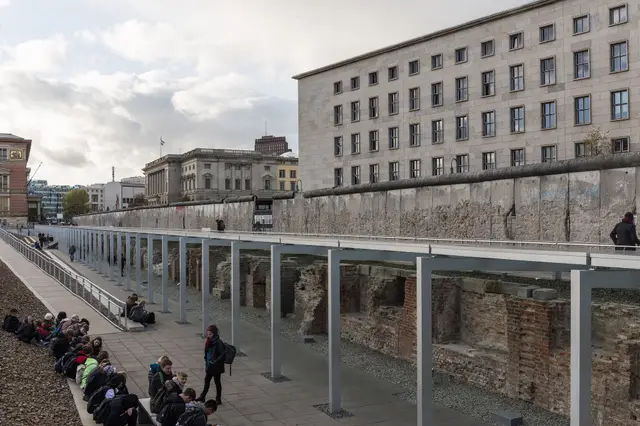
What you see today: 1.3 km of former border wall along Mühlenstraße 47–80, open around the clock and free.13 This was the hinterland wall; the river behind it was the border.
What happened here: in August 1965 a 31-year-old miner went through the ruins in the strip, left his bag and papers on the bank and swam the Spree. In December 1971 two 20-year-old border guards seized their patrol boat at Mühlenstraße 74/77 and crossed to Kreuzberg in daylight. At least seven men died trying to cross the Spree along this stretch.14 Victims of the Wall covers drownings at the Wall.
In 1986 a teenage couple climbed the Wall on the eastern bank with boards from a wooden fence and swam across; the record does not say exactly where.
Stop 2: Oberbaumbrücke
Getting there: about 640 m, 9 minutes (back along the Wall and over the bridge).
What happened here: on 25 August 1961 a young man slipped in among the construction workers at the bridge's control point and walked away into West Berlin.
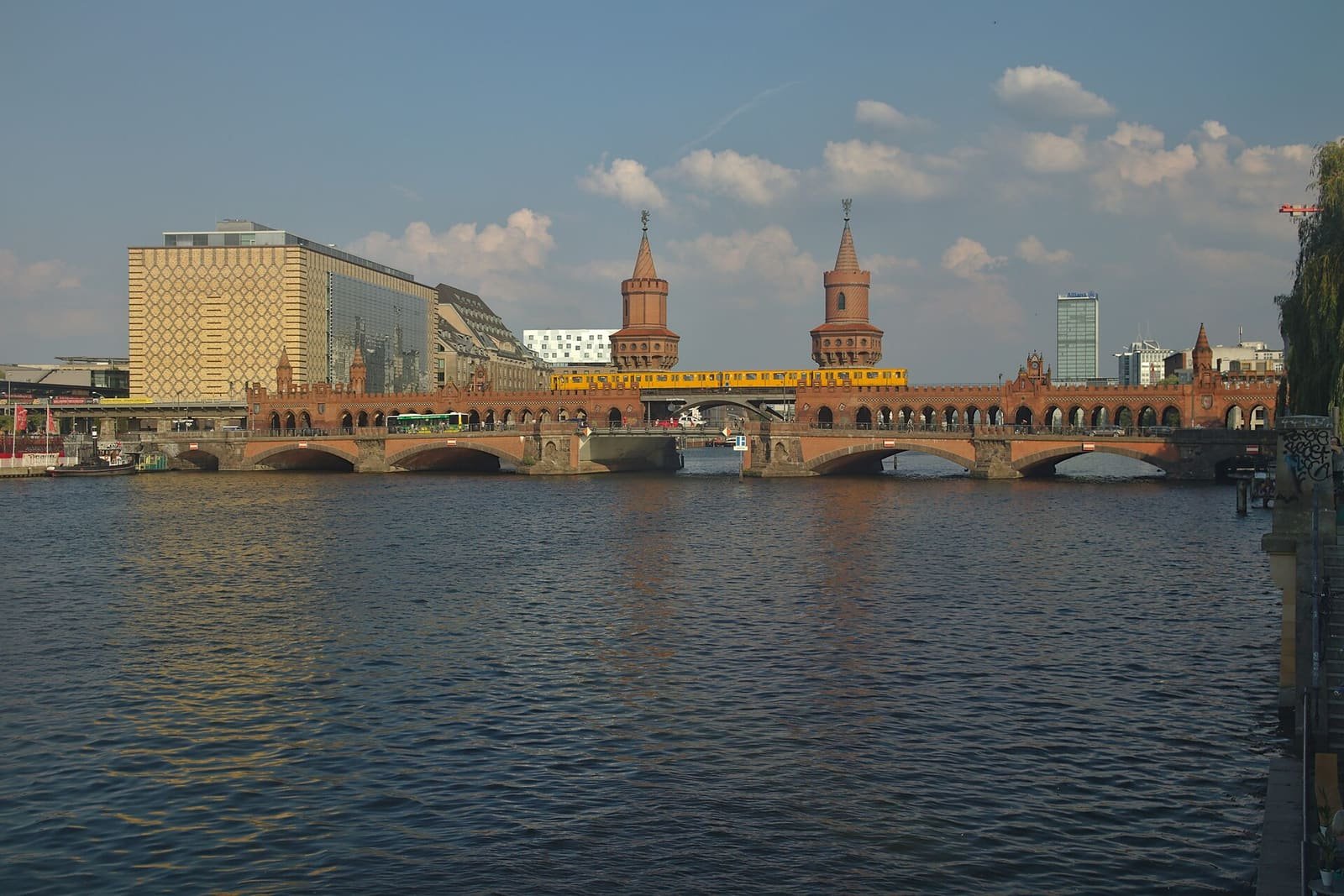
Stop 3: the Kreuzberg bank
Getting there: about 160 m, 2 minutes.
What happened here: from this bank you can see the stretch of river where the railway worker Udo Düllick drowned under fire in October 1961, just short of the western side. His story belongs on Victims of the Wall.
Stop 4: Am Flutgraben, the last East Berlin border house
Getting there: about 930 m, 12 minutes.
What you see today: the workshop building Am Flutgraben, now the Kunstfabrik studio house, is the only East Berlin border house that survived the building and expansion of the barriers. It still has its bricked-up windows, the catwalks added to the roof in 1988, and about 50 inscriptions left by border guards in the attic.15
What happened here: the building belonged to the VEB OLW works, and it was itself part of the border. A Stasi report of September 1961 says eight people had fled across the Flutgraben from the works in recent days. In 1962 a man worked his way along the ornamental brickwork of the façade and jumped to the West, after which the protruding brick courses were knocked off. Nearby at the Puschkinallee, two guards let a woman with a baby and a boy through in September 1961.
Stop 5: Heidelberger Straße at Elsenstraße
Getting there: about 1.5 km, 19 minutes.
What you see today: Heidelberger Straße was the street most often tunnelled under in Berlin. The border ran along it, so one side was Treptow in the East and the other Neukölln in the West; over 100 people escaped through tunnels from Treptow to Neukölln.16
What happened here: in April 1963 the 19-year-old Wolfgang Engels drove a stolen armoured personnel carrier into the Wall, was shot as he climbed out, got over the Wall wounded and was pulled into the West. In October 1962 a tunnel from the Heidelberger Krug pub brought a tailor couple out in their pyjamas before an informer betrayed it.
Stop 6: the Pfingsttunnel, Heidelberger Straße 81
Getting there: a few steps along Heidelberger Straße.
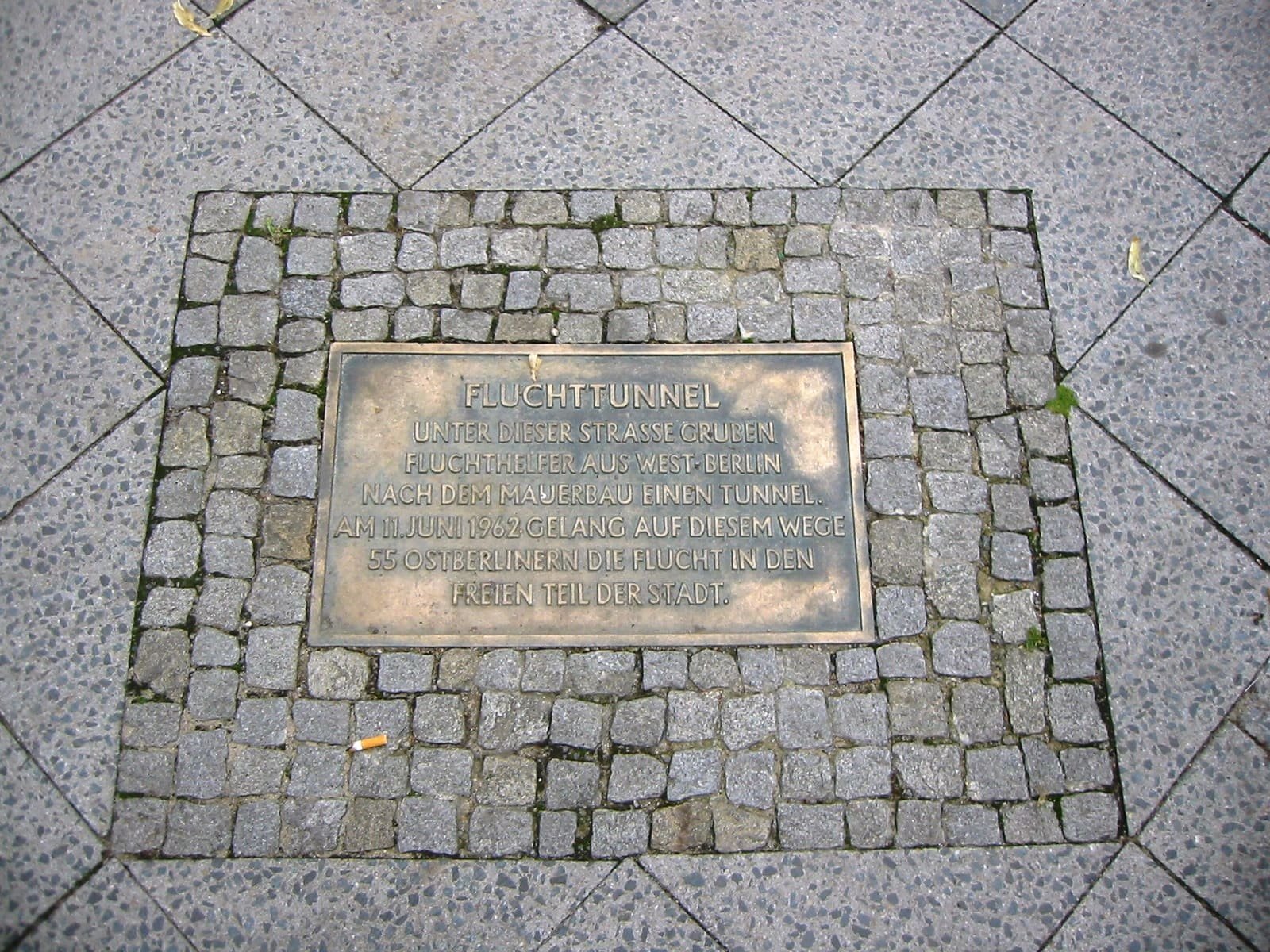
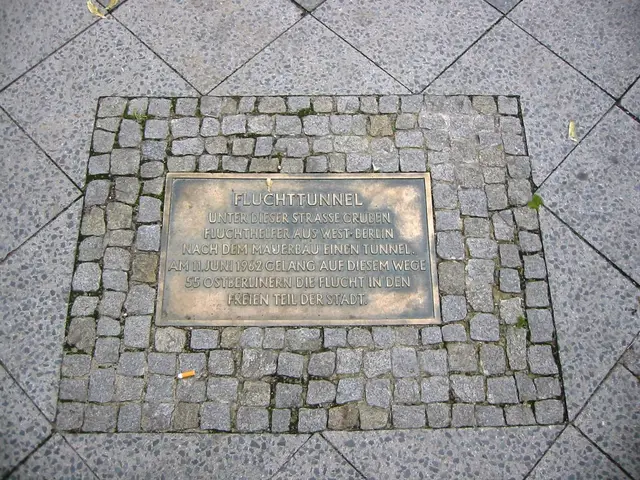
What you see today: a plaque from 2005 at Heidelberger Straße 81 reads: "Under this street escape helpers from West Berlin dug a tunnel after the Wall was built. On 11 June 1962, 55 East Berliners escaped this way."17 Other sources give lower numbers, from 54 down to about 20; the Pfingsttunnel record lists them.
What happened here: as early as 17 August 1961, a man ran out of no. 79, jumped the barrier fence and went into a soap shop on the West Berlin side of the street.
Stop 7: Heidelberger Straße 35, the Jercha plaque
Getting there: about 150 m, 2 minutes.
What you see today: a plaque unveiled on 27 March 2012 says about 50 people escaped through the tunnel from this house between 22 and 27 March 1962.16 Chronik der Mauer puts the number at "dozens", and the two sources differ on where the ricochet hit the escape helper Heinz Jercha; the record sets out both. For his life, see Victims of the Wall.
What happened here: a year later helpers dug a second tunnel from the same house to no. 75, and up to 20 people got through before a resident noticed a broken cellar door. More on these and other tunnels in Berlin Wall escape tunnels.
Finish at S Treptower Park, about 1.4 km or 19 minutes away.
Add-on A: Potsdamer Platz to Checkpoint Charlie
About 1.8 km, 24 minutes. Nearest U-Bahn at the end: U6 Kochstraße. The records are on the Checkpoint Charlie place page.
- Detlev-Rohwedder-Haus (about 720 m from Potsdamer Platz). In July 1965 the Holzapfel family hid in what was then the Haus der Ministerien, climbed onto its roof after dark and slid over the Wall on a steel cable.
- Zimmerstraße 9 (about 400 m). A ground plaque marks where two brothers and a friend came up from a short tunnel in January 1972.
- Checkpoint Charlie (about 260 m). A lorry with five tonnes of gravel smashed through in 1986; in 1963 an Austin-Healey Sprite drove under the barrier; and in 1961 Hasso Herschel walked out on a Swiss passport. The Berlin Wall Foundation shows a temporary outdoor exhibition, "Crossing the Iron Curtain", on the square in front of the Asisi Panorama.18
- Peter Fechter memorial (about 240 m). Peter Fechter was shot here in August 1962; read who he was on Victims of the Wall.
- Zimmerstraße 56 (about 190 m). Rudolf Müller's tunnel of June 1962, which cost the life of a young border guard.
Add-on B: the canal and the Litfin memorial
About 2.9 km, 39 minutes, from U6 Naturkundemuseum to Berlin Hauptbahnhof. See the Invalidenstraße and Humboldthafen place page.
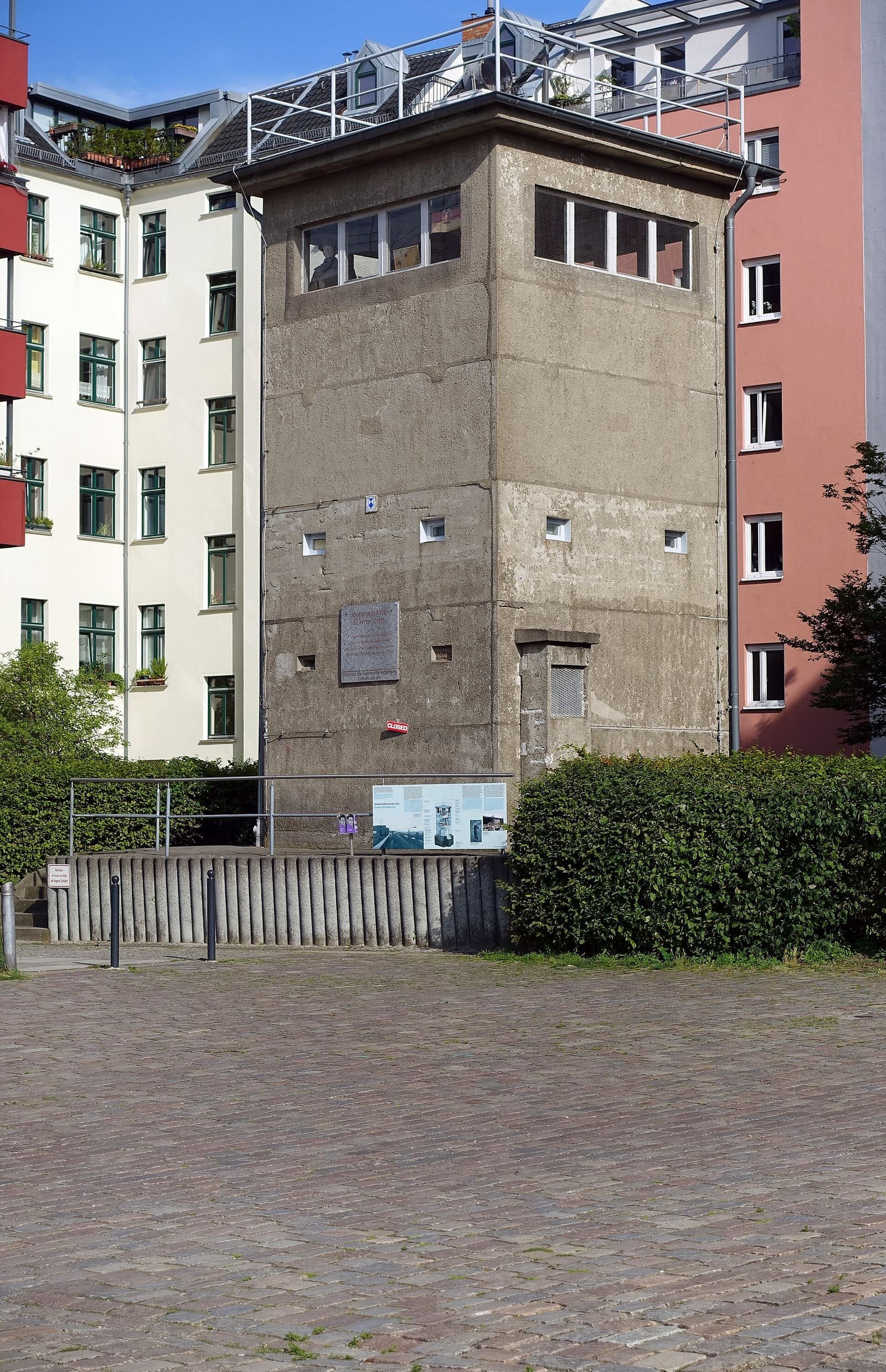
- Günter Litfin memorial, Kieler Straße 2 (about 1.2 km). A preserved border watchtower on the canal, dedicated to Günter Litfin, the first refugee killed by targeted shots at the Wall, in the Humboldthafen in August 1961. His story is on Victims of the Wall. It is not part of the Bernauer Straße memorial grounds.
- Invalidenfriedhof (about 300 m). The border ran along the canal here; the border troops levelled part of the cemetery in 1961, and a piece of hinterland wall and the patrol road across the graves can still be seen.11 In May 1962 a 14-year-old swam the canal under fire.
- Sandkrugbrücke, the former Invalidenstraße crossing (about 640 m). A person in a white coat from the Charité jumped the barrier in 1961; a steel-plated bus stopped a metre short of the West in 1963; the Interflug driver's girlfriend rode through in the spare-wheel box in 1964; and in 1978, according to the West Berlin police, two East Germans left in a Belgian diplomat's car (the press named Checkpoint Charlie).
- Alexanderufer (about 480 m), then Hauptbahnhof (about 280 m).
For more of these vehicle escapes, see the most ingenious Berlin Wall escapes.
Practical tips
- Which walk? With half a day, do Route 1. With a full day, add Route 2 in the afternoon: from U Eberswalder Straße the M10 tram runs straight to Warschauer Straße.
- Opening hours. Bernauer Straße grounds: daily 8 a.m.–10 p.m. Visitor Centre and Documentation Centre: Tuesday–Sunday 10 a.m.–6 p.m., free. On Mondays you can still walk the route, but the tower is shut.1 The East Side Gallery is open around the clock.13
- Litfin memorial. berlin.de gives May to October, Saturday and Sunday 11 a.m.–5 p.m., free, with public tours on Saturdays at 2 p.m. from April to October.12 Victims of the Wall gives the 2026 season as May to early October, with occasional special openings.20 The listings don't agree, so check the Foundation's visitor page before you go.
- Tunnel tour. Book Berliner Unterwelten's "Under the Berlin Wall" online in advance; it does not sell tickets on the day.10
- Map. The escape map on the homepage shows every record on this site. For the numbers behind the walk, see how many people escaped the Berlin Wall.
Want the stories told on the spot?
The same one-hour tour also takes in the Nordbahnhof ghost station.19 For Add-on A, Berlin Experiences' one-hour Cold War Berlin Tour meets at Potsdamer Platz and goes past the Holzapfel escape site to Checkpoint Charlie.
Questions and answers
- Where can I see Berlin Wall escape sites on a self-guided walk?
- Bernauer Straße is the best single place: in about 2.8 km from S Nordbahnhof to U Eberswalder Straße you pass the sites of Tunnel 57, Tunnel 29, Conrad Schumann's jump and the houses people jumped from in 1961. A second walk from Warschauer Straße follows the Spree to Heidelberger Straße in Treptow and Neukölln, the street most often tunnelled under in Berlin.
- Where exactly was Tunnel 57?
- It ran about 145 m from a former bakery at Bernauer Straße 97 in Wedding to Strelitzer Straße 55 in East Berlin. Steel plates in the lawn of the Berlin Wall Memorial mark its course, a plaque hangs in the entrance passage of Bernauer Straße 97, and another is on Strelitzer Straße 55.
- Where did Conrad Schumann jump the Wall?
- At the corner of Bernauer Straße and Ruppiner Straße, on 15 August 1961. A Berlin Wall History Mile panel stands at the corner and a sculpture of the jump is on the former border strip nearby.
- Can you go inside a Berlin Wall escape tunnel?
- Yes. Berliner Unterwelten's 90-minute 'Under the Berlin Wall' tour starts at Brunnenstraße 141 and goes into the one original escape tunnel still visible, dug in 1970–71. Tickets are sold online only and the tour is not for children under 7.
- How long does the Bernauer Straße walk take?
- About 37 minutes of walking for roughly 2.8 km, but allow two to three hours with stops, the tower and the Documentation Centre. The distances are estimates, based on straight lines between stops plus 30 per cent.
Sources
- Information for your visit (Berlin Wall Memorial)Stiftung Berliner Mauer
- Digital GuideStiftung Berliner Mauer
- Tunnel escapes (Berlin Wall Memorial Digital Guide)Stiftung Berliner Mauer
- Flucht durch den 'Tunnel 57', 3./4. Oktober 1964Chronik der Mauer
- Gedenktafel 'Tunnel 57'Orte des Erinnerns
- Fluchttunnel, Bernauer Straße 97Gedenktafeln in Berlin
- Info panel about Tunnel 29 on Schönholzer StraßeStiftung Berliner Mauer
- Geschichtsmeile Berliner Mauer: Conrad Schumann (panel text, PDF)Bezirksamt Mitte / berlin.de
- Bernauer StrasseStiftung Berliner Mauer
- Under the Berlin WallBerliner Unterwelten e.V.
- InvalidenfriedhofChronik der Mauer
- Gedenkstätte Günter Litfinberlin.de
- East Side Gallery: map and informationStiftung Berliner Mauer
- Flucht im Bereich Mühlenstraße (East Side Gallery exhibition)Stiftung Berliner Mauer
- Am FlutgrabenLandesdenkmalamt Berlin
- Gedenktafel für Heinz Jercha, Heidelberger Straße 35Museen Treptow-Köpenick / berlin.de
- Pfingsttunnel 1962Museen Treptow-Köpenick / berlin.de
- Checkpoint CharlieStiftung Berliner Mauer
- Berlin Wall TourBerlin Experiences
- Berlin Wall victims' memorialsVictims of the Wall
Facts taken from an escape record on this site link to that record, which lists its own sources.
Spotted an error, or know more? Email us a correction or addition
Escapes in this article
3 October 1964 – 5 October 1964
Tunnel 57
57 East Berliners crawled through a 145-metre tunnel dug by West Berlin students under Bernauer Straße. The escape ended in a shoot-out in which border guard Egon Schultz was killed; records opened after 1990 showed the fatal shots came from a fellow GDR soldier.
14 September 1962 – 15 September 1962
Tunnel 29
Around 30 helpers, mostly students, dug a tunnel from a factory on Bernauer Straße to a cellar in East Berlin; 29 people escaped through it over two days while an American TV crew filmed.
15 August 1961
Conrad Schumann's leap to freedom
Two days after the border was sealed, 19-year-old border policeman Conrad Schumann jumped over the barbed-wire barrier at Bernauer Straße into West Berlin, dropping his submachine gun as he went.
19 September 1961
Heavily pregnant Helga Knittel jumps first
The Knittel family called the West Berlin fire brigade, then jumped one after another from their second-floor window into its net: first the heavily pregnant mother, then the daughter, then the father.
February 1971
Tunnel 71 – The Last Tunnel under Bernauer Straße
Hasso Herschel's team lived underground for nine weeks digging a tunnel beneath Bernauer Straße, but came within ten metres of their goal before GDR border troops dug it up.
1 December 1971
Two border guards take a patrol boat across the Spree
In December 1971 two 20-year-old GDR border guards disarmed a comrade, took the patrol boat moored at Mühlenstraße and crossed the Spree to Kreuzberg in broad daylight.
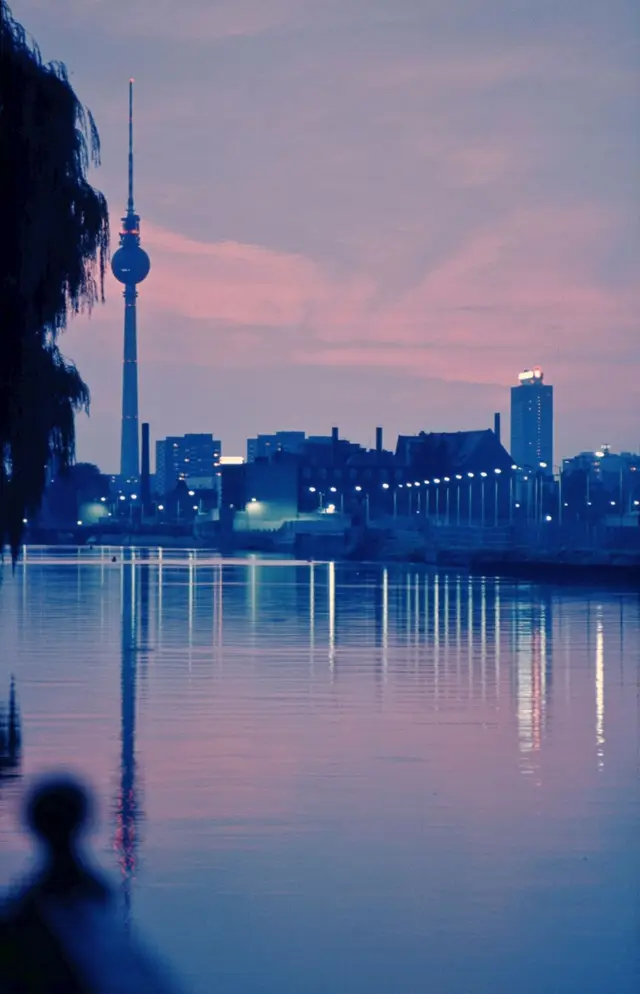
17 April 1963
Wolfgang Engels' armoured personnel carrier
A 19-year-old civilian army employee drove a stolen Soviet-built armoured personnel carrier into the Wall and was shot while climbing over, but was pulled into the West.
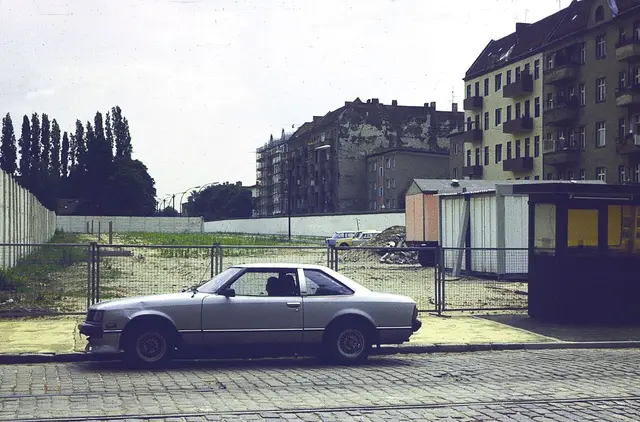
9 June 1962 – 11 June 1962
The Whitsun Tunnel (Pfingsttunnel)
In June 1962 helpers around Harry Seidel dug from the cellar of a Neukölln corner pub under Heidelberger Straße and, over the Whitsun weekend, brought East Berliners out through a photographer's shop.
More articles
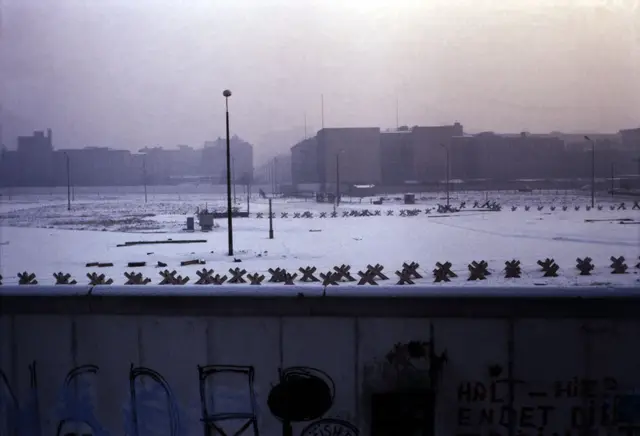
The numbers
How Many People Escaped the Berlin Wall?
The figure of 5,075 comes from a West Berlin police count. Here is where it comes from, how it fell year by year, and what several hundred documented escapes add to it.
Tunnels
The Tunnels Under the Berlin Wall: Who Dug Them, Who Got Out
Students dug in from the West, families dug out from the East, and the Stasi waited at the far end of many. How the tunnels worked, why most failed, and where you can still see one.
How they did it
The Most Ingenious Berlin Wall Escapes, and How They Worked
A cable from a ministry roof, a train that didn't stop, a bubble car with a person behind the seat. Eleven escapes that were engineered rather than lucky, with the measurements and the places the sources disagree.