Articles · Defectors in uniform
The Guards Who Ran: Border Soldiers Who Fled Over the Wall
Everyone knows the photograph of Conrad Schumann leaping the wire. He was one of hundreds of East German guards, soldiers and policemen who fled, and the regime rebuilt its whole border watch around stopping them.
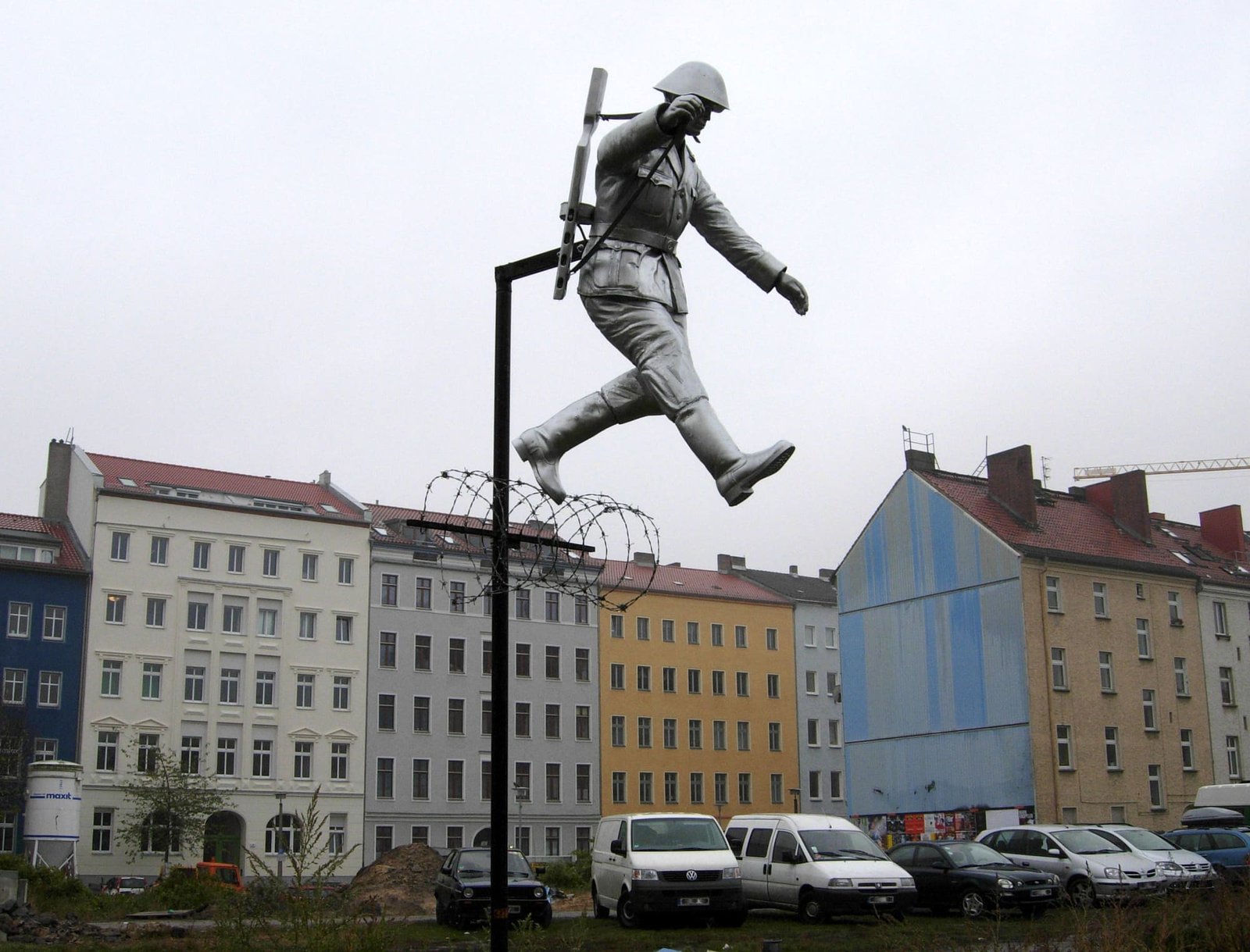
At about four in the afternoon on 15 August 1961, a 19-year-old policeman stood at the corner of Bernauer Straße and Ruppiner Straße, where the new border was still only a coil of barbed wire. When nobody on his side was looking, he pressed the wire down a little and signalled to the photographers on the western side. West Berlin police parked their car a few metres from the wire and left the rear door open. Then he ran, jumped, let his submachine gun slide off his shoulder, and was driven away at speed.23
His name was Conrad Schumann, and the picture of that jump went round the world with a simple message: the GDR's own troops were running away.1 What the picture doesn't show is how many others did the same. The West Berlin police later counted 574 members of East Germany's "armed organs" among the people who escaped over the barriers in Berlin.6 This article is about them: who ran, when, how they got past the comrade standing next to them, and what the regime did to stop the next one.
15 August 1961, about 4 p.m.: the jump
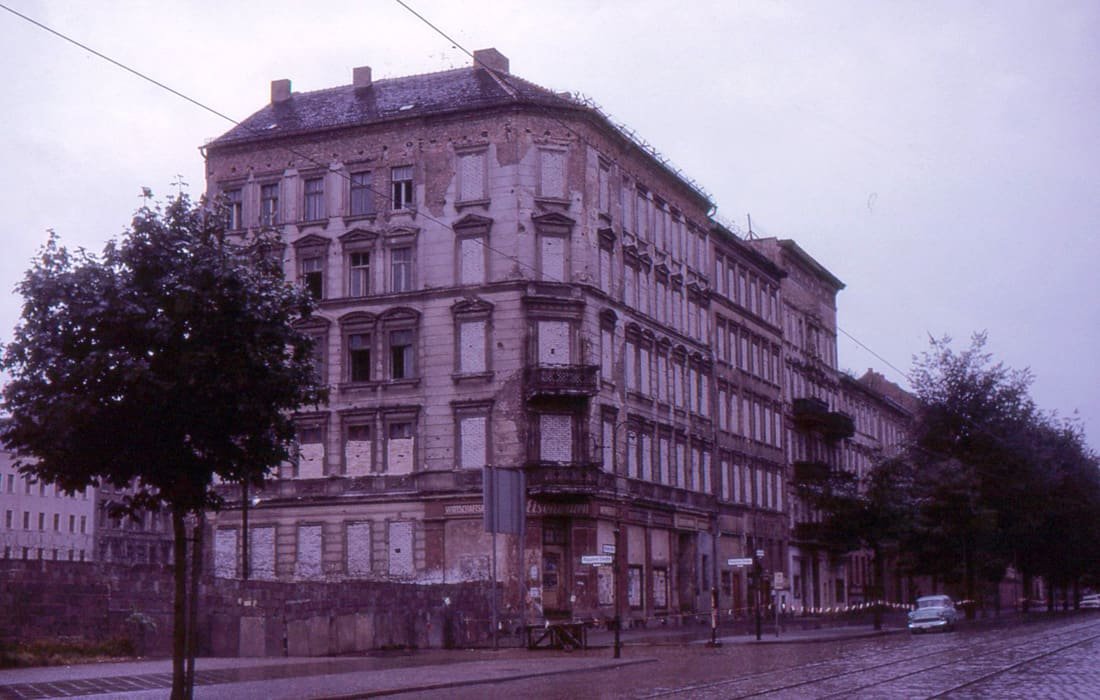
Schumann was a trained shepherd from Zschochau in Saxony. In the early hours of 12 August 1961 his brigade had been moved from Dresden to the Berlin sector border, with a "danger bonus" of 30 Ost-Mark on top of his pay.1 The Chronik der Mauer calls him the first border policeman to escape at that spot.1 He later said he decided to go after watching guards turn back a little girl who had been visiting her grandmother in the East, while her parents waited a few metres away on the western side.1
The sources don't agree on every detail, and the record of his escape sets them out. The Berlin Wall Foundation and Wikipedia say about 4 p.m.;23 the East Berlin police journal of that day gives 15.40.14 The same journal first reported that he had been dragged through the wire by force, then corrected itself and said he had got caught in the wire and been freed by West Berlin policemen. The getaway vehicle is a West Berlin police car in the Foundation's account and an Opel Blitz van in Wikipedia's.23 His rank also varies: border policeman, Bereitschaftspolizist (police reserve) or, in the police journal, Oberwachtmeister. He was not a soldier of the National People's Army (NVA), although some captions, including those of photos of his memorial sculpture, call him one.
Two cameras caught the moment. Dieter Hoffmann, filming for Sender Freies Berlin, recorded the jump on 16 mm film, and Peter Leibing, a trainee with the Hamburg agency Conti-Press, took the famous still.3 Klaus Lehnartz, who stood nearby, claimed the photo as his own; from 1981 an injunction barred him from doing so. Because Leibing took it on the agency's behalf, the fees went to Conti-Press, not to him.3 Since 2011 the picture has been part of UNESCO's Memory of the World register, among the documents on the building and fall of the Wall.3
You won't find Leibing's photograph on this page. The Berlin company conibeta GmbH states that it holds the full licence to it and grants rights only for set purposes and periods.4 Copies on Wikimedia Commons tagged as US government public domain, because the picture appeared in a CIA booklet, don't change that: the CIA didn't take it, Leibing did.3 You can see the picture on the fire wall of a building at the corner itself, as the Foundation's digital guide points out, and the Chronik der Mauer's page on his escape shows photographs of the jump.21 The Chronik der Mauer catalogues the 2000 WDR documentary Sprung in die Freiheit (directed by Jochen Voigt, camera Dieter Hoffmann, 43 minutes).13
Schumann settled in Bavaria. He never thought of himself as a hero, and in 1998 he took his own life.1
He wasn't alone: the first weeks
Schumann's jump was the one photographed. It was not unusual. On 20 August 1961 the Stasi reported that in the week since 13 August there had been 24 desertions among the police reserve units, border police and factory militia groups deployed to seal the border around West Berlin, and that 18 more men suspected of planning to desert had been identified.5 Its recommended remedies read like a list of everything that would follow: better selection, political education, removing unreliable men, completing the oath-takings and closer surveillance.5
On this site almost 30 records of guard defections fall in August 1961 alone, and more than half of all the guard defections recorded here are from 1961. The defections page lists them all, and the 1961 year page puts them among the other escapes of that year.
The methods were simple, and they tell you what the border looked like before it was a wall:
- On the evening of 16 August a riot policeman on patrol near the Kiesberg in Treptow said he was going into the bushes to relieve himself. He didn't come back (Ulrich H.).
- The next night a cadet crawled under the wire at Grüneck in Altglienicke while the second man on the post slept (Günter D.). Five days later two pioneers who were putting up fences at the same allotments went through the fence they were building.
- In Heidelberger Straße a policeman asked his partner to go and see what a West Berlin patrol car was doing, then climbed the fence while he was gone.
- Two patrolmen on Kiefholzstraße had told two comrades the day before; the two kept quiet and were arrested afterwards.
- In October a dog handler training his successor in the Sophien cemetery made an excuse and went over the cemetery wall, and a day later a policeman left his partner on a pretext and jumped from a flat at Bernauer Straße 2, with two friends from his unit already gone before him.
Several of these rest on a single document, usually one entry in the East Berlin police journal or one Stasi report with the names shortened, and the records say so.
How many? The numbers and what they cover
Three figures turn up again and again, and they measure different things. They can't be added together or compared as if they did.
- 574GDR soldiers and police escaped into West BerlinBerlin, all armed organs, 1961–1989. West Berlin police count.Chronik der Mauer
- 1,933successful desertions from the border troopsAll GDR borders, 1961–1989, Stasi figures. About three times as many were stopped in advance.bpb Deutschland Archiv
- 24desertions in the first weekBerlin, 13–20 August 1961, Stasi report 462/61.DDR im Blick
The 574 comes from the West Berlin police's "Mauerstatistik", as of 31 December 1989. It counts 5,075 people who escaped over the barriers in Berlin between 13 August 1961 and the end of 1989, of whom 574 were members of the GDR's "armed organs".6 That is Berlin only, and it includes soldiers and police as well as border troops: about one escaper in nine.
The 1,933 comes from the Stasi. Its statistics show 1,933 successful desertions from the border troops between the building of the Wall and its fall, and about three times as many desertions stopped in advance.7 It counts the border troops as a whole, which guarded the long border with West Germany as well as Berlin, so it is not a Berlin figure.
The 24 is the first week in Berlin, from the Stasi report quoted above.5
Other Stasi counts cut the numbers differently again. The Stasi's Main Department I recorded 2,229 members of the NVA and border troops who deserted and fled the GDR between 1 January 1961 and 31 August 1986.8 Over a longer span it counted 10,756 deserters from the NVA, border troops and other armed units between 1950 and mid-1987, but 8,278 of them left before 31 July 1961, while the border was still open.7
The trend is clear in all of them. By the 1970s and 1980s the Stasi listed only a little over a dozen deserters a year; the Bundesarchiv puts that down to the expanded barriers and the closer watch on the soldiers themselves.8 German Wikipedia's article on the border troops, drawing on the historian Rüdiger Wenzke, still calls desertion a permanent problem for them.12 The records on this site show the same shape: a flood in 1961, a trickle afterwards.
The regime's answer: trust no pair
The man most likely to stop a guard from escaping was the guard beside him, so the GDR built its border watch around that fact. Preventing desertion and treason in the NVA and the border troops, "especially for border soldiers", was the job of a whole Stasi department, Main Department I.10 Pulling the published rules together, a patrol pair was put together like this:
- Weed out the doubtful. Conscripts with "desertion remarks" or other doubts were kept away from the border altogether. In 1985 the Stasi stopped 850 conscripts called up for the border troops from serving there and had 535 withdrawn from border units: 1,385 in all, after 1,150 in 1984 and before 1,506 in 1986.7 In the late 1980s there were between two and nine of these quiet transfers away from the border, the so-called Abversetzungen, every day.7
- Grade everyone, every week. Soldiers were assigned weekly by reliability criteria, known internally as "blood groups", in four main categories.9
- Never the same pair twice. Two men were not to be put on duty together twice, or too soon after each other.9
- No friends, no neighbours. Men from the same town, school or workplace were not deployed together, nor were relatives or close friends.9
- Tell them at the last minute. Soldiers learned who their partner was only at the Vergatterung, the formal order given just before going on duty.9
- Watch each other on post. Each man was there to keep an eye on the other as well as on the border, as a UPI report on one pair that ran anyway put it.
- Watch the watchers. Through its "Verwaltung 2000" the Stasi had informers "in every room, in every unit".9
- Keep watching afterwards. When a man got away, the Stasi kept working on the case for at least two years, reading the letters he sent to family and friends at home.8 Its own desertion files, with reports on how each one happened, photos, maps and personnel papers, fill 58 metres of shelving in the archive today, and only about 6 per cent has been catalogued.11
Jens Bernhardt, who fled in 1987, described the result from the inside: guards always served in pairs, but partners and towers were changed so that trust couldn't grow (record).
Beating the system: notable cases
The rules made desertion harder. They didn't stop it. The later cases on this site show men working around the pair, or turning it inside out.
- A crawler tractor. In October 1963 a 22-year-old border policeman given levelling work in the death strip at Wilhelmsruh drove a crawler tractor through the wire. It stuck halfway, so he finished on foot.
- A stolen boat. On 1 December 1971 the commander and the engineer of patrol boat 673 on the Spree made the third crew member get off, then crossed about 80 metres to Kreuzberg in the middle of the day.
- Their own gate. At the Fichtewiese exclave in Spandau, guards checked the passes of West Berlin allotment holders going through a gate in the Wall. On 11 June 1978 one of them ran through it (an AP report says he climbed a remote stretch of the Wall instead). According to the US Mission the whole company was relieved of duty, and six days later a guard from the new company escaped in exactly the same way. The second escape rests on a US Mission telegram alone.
- The pair ran together. In December 1983 two guards who were meant to watch each other swam the Teltow Canal together, flagged down a car and telephoned the police from a café. The only source is a UPI report.
- Beer afterwards. In August 1986, days after the Wall's 25th anniversary, two guards who had met on duty two weeks earlier gave each other a leg-up over the Wall at Groß Ziethen, threw their guns back into the East and walked into a West Berlin tavern.
- Disarming the partner. In July 1987 Jens Bernhardt waited until his tower partner fell asleep, hid the man's ammunition and climbed the fence into Spandau with metal hooks. In November 1988 a guard at the Ostpreußendamm in Steglitz took the bolt out of his partner's submachine gun before crossing; that one is known from a single short taz item.
Rank was no protection. In February 1962 an NCO knocked down his squad leader and took his sister and her friend with him. In October 1968 a deputy company commander facing a dressing-down after a drunken farewell party took a painter's ladder from a house at Stolpe-Süd and climbed out in uniform. The same day a patrol-boat commander on the Havel at Sacrow asked to go ashore to relieve himself, at the exact point where the land border met the water.
18 October 1963
Border policeman crashes a crawler tractor through the wire
A 22-year-old border policeman assigned to levelling work broke through the wire barriers between Wilhelmsruh and Reinickendorf with a crawler tractor; when it stuck halfway, he continued to the West on foot.
1 December 1971
Two border guards take a patrol boat across the Spree
In December 1971 two 20-year-old GDR border guards disarmed a comrade, took the patrol boat moored at Mühlenstraße and crossed the Spree to Kreuzberg in broad daylight.

23 December 1983
Two border guards meant to watch each other swim the Teltow Canal together
At about 1 a.m. on 23 December 1983 two East German border guards, paired so that each could watch the other, swam the Teltow Canal in uniform to a suburb in the American sector. They flagged down a car and were driven to a café, from where they called the police.
28 November 1988
A border guard disables his partner's gun and crosses at Ostpreußendamm
On 28 November 1988 a member of the GDR border troops fled to West Berlin with his weapon at the Ostpreußendamm in Steglitz, after removing the bolt from his patrol partner's submachine gun.
Guards who helped others through
Some guards took others with them, or let them pass. Rudi Thurow, a volunteer in the border police since 1955, learned that acquaintances were planning to flee and decided to go with them instead of reporting them. On 21 February 1962 he removed the bolts from the border posts' submachine guns and led the group on foot and in uniform to the West Berlin enclave of Steinstücken. Shots were exchanged but nobody was hurt, and American helicopters flew the refugees out. In West Berlin he became an escape helper himself; the sources disagree on how long, until 1966 or until 1975. More on people like him is in the escape helpers article.
Others helped without leaving. On 6 September 1961 a woman came to a post on the Puschkinallee in Treptow and asked a guard to let her through to her husband, who was waiting on the western side. He told her to come back after dark. At 8.30 p.m. she came back, and the two guards let her through with a four-month-old child and a boy. A third guard reported it after the shift changed, and the guard she had spoken to was given ten days' arrest.
The price: kidnapped, shot, imprisoned
Getting over was not always the end. Gerd Sommerlatte, a young policeman born in 1943 and posted to the Brandenburg Gate, fled across the wire there on 10 September 1961 rather than risk having to shoot at people. Less than three weeks later two men he had befriended in the Marienfelde reception camp took him back to East Berlin on the Stasi's behalf. He was sentenced to ten years and released only when West Germany bought his freedom in 1965.
For others the attempt was fatal. Transport policeman Hans-Dieter Wesa was shot by his post partner at Bornholmer Straße in 1962 after he had already reached West Berlin ground. Conscript Michael Kollender was shot running for the Teltow Canal in 1966. Border policeman Georg Feldhahn vanished at the Teltow Canal in December 1961 and was found drowned months later, Willi Born died near Bergfelde in 1970, and the deserting policeman Horst Körner was shot dead near Klein Glienicke in 1968. Their stories are told in full on victimsofthewall.com.
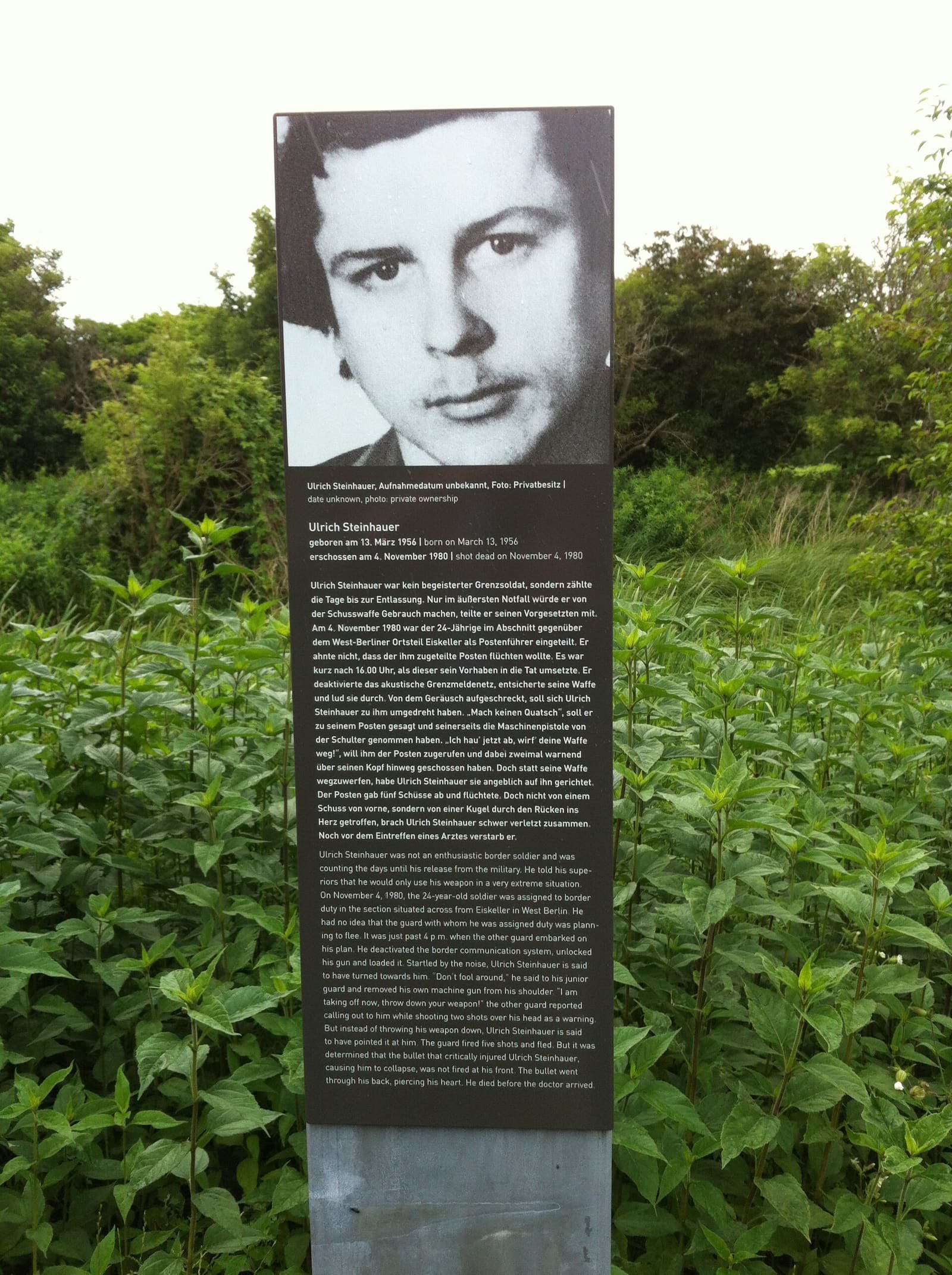
Some deserters killed to get out. Border guards Jörgen Schmidtchen (1962), Rolf Henniger (1968) and Ulrich Steinhauer (1980) were shot by men fleeing to the West; their story is in Border soldiers killed at the Berlin Wall.
Visit
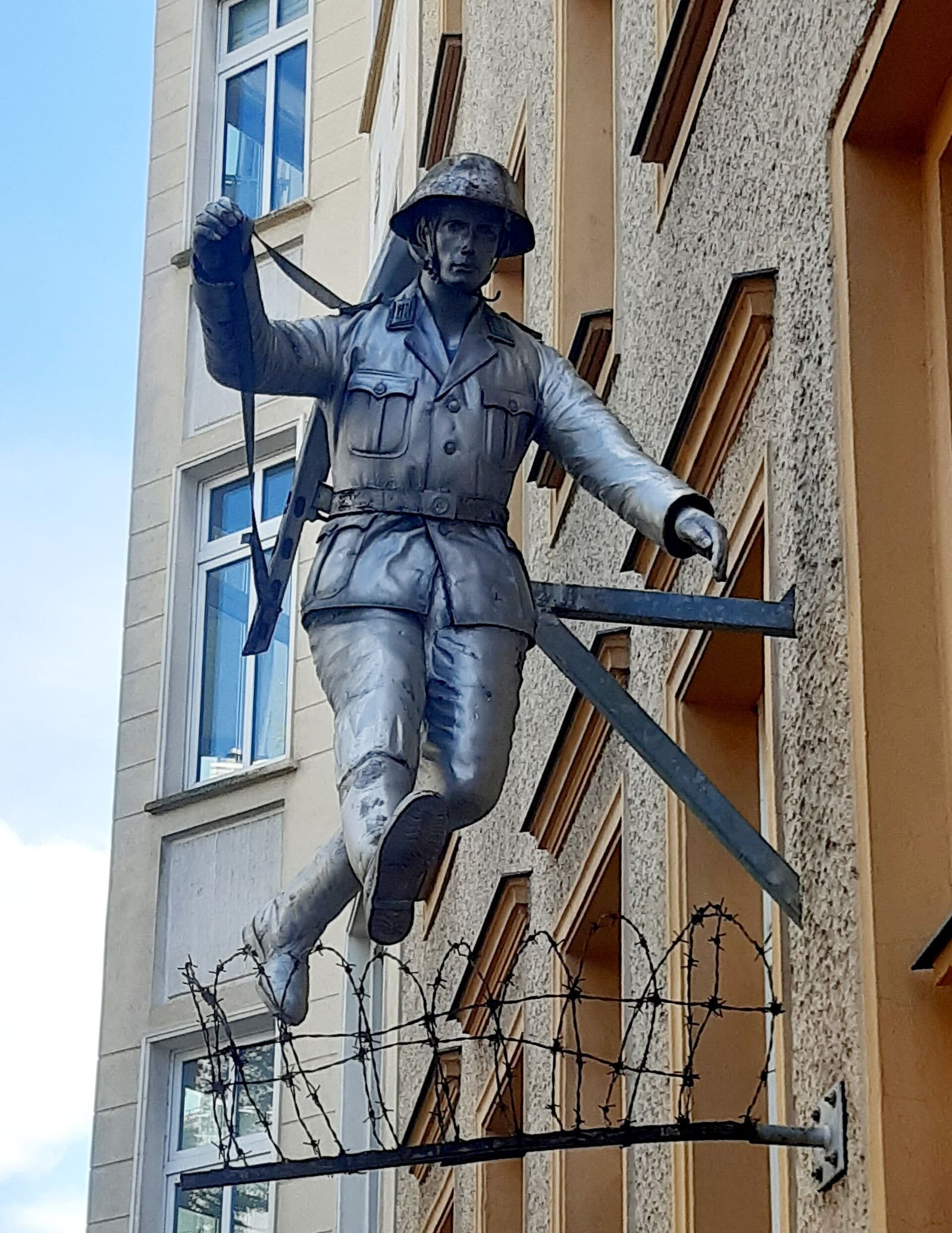
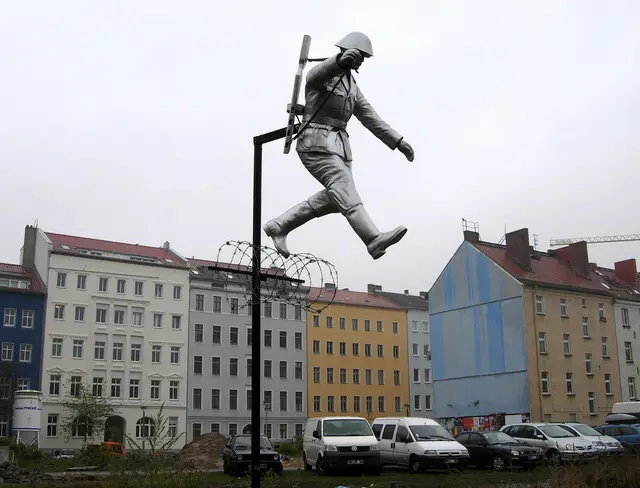
The corner where Schumann jumped is now part of the Berlin Wall Memorial grounds on Bernauer Straße, and a sculpture of his leap stands on the old border strip nearby. The Bernauer Straße page lists the other escapes along the street, and the walking tour of escape sites links it with the rest of the route.
For more on what it took to get across, and how many made it, see how many people escaped the Berlin Wall.
Questions and answers
- How many East German border guards escaped over the Berlin Wall?
- The West Berlin police counted 5,075 people who escaped over the barriers in Berlin between 13 August 1961 and the end of 1989, including 574 members of the GDR's 'armed organs': border troops, soldiers and police. Stasi statistics give 1,933 successful desertions from the border troops between 1961 and 1989, but that figure covers the whole GDR border, not just Berlin.
- Who was the first border guard to escape over the Berlin Wall?
- Conrad Schumann, a 19-year-old border policeman, jumped the barbed wire at Bernauer Straße on 15 August 1961 and is the best known. He was not the only one that week: a Stasi report counted 24 desertions among the forces guarding the border around West Berlin between 13 and 20 August 1961.
- Who took the photo of Conrad Schumann's jump?
- Peter Leibing, then a trainee with the Hamburg agency Conti-Press. Klaus Lehnartz, who stood nearby, claimed the picture as his own and was barred from doing so by injunction from 1981. Since 2011 the photo has been part of UNESCO's Memory of the World register.
- What happened to Conrad Schumann after his escape?
- He settled in Bavaria, where he lived and worked. He never considered himself a hero, and he took his own life in 1998.
- How did East Germany stop border guards from escaping?
- Guards patrolled in pairs that were never repeated, with no men from the same town, school or workplace and no relatives or friends together, and they learned who their partner was only at the briefing just before duty. The Stasi had informers in every unit and quietly moved doubtful conscripts away from the border.
Sources
- „Sprung in die Freiheit“: Die Flucht des DDR-Grenzpolizisten Conrad Schumann, 15. August 1961Chronik der Mauer
- Leap over the Barbed Wire (Digital Tour Guide)Stiftung Berliner Mauer
- Sprung in die FreiheitWikipedia (de)
- Sprung in die Freiheit: licensingconibeta GmbH
- Einzel-Information Nr. 462/61 über erfolgte Fahnenfluchten von Angehörigen der Bereitschaftspolizei, 20. August 1961Stasi-Unterlagen-Archiv, DDR im Blick
- Gelungene Fluchten aus der DDR und Ost-Berlin durch die Grenz-Sperranlagen 1961–1989Chronik der Mauer
- Jochen Staadt and Jan Kostka, Todesopfer des DDR-Grenzregimes. Eine Recherche (Deutschland Archiv, 2019)Bundeszentrale für politische Bildung
- Ein Stofffetzen am GrenzzaunBundesarchiv (Stasi-Unterlagen-Archiv)
- Peter Joachim Lapp, „Hauptaufgabe“ FluchtverhinderungBundeszentrale für politische Bildung
- MfS-Lexikon: Hauptabteilung I (NVA und Grenztruppen)Bundesarchiv
- Archivbestand 8: Akten über FahnenfluchtBundesarchiv
- Grenztruppen der DDRWikipedia (de)
- Sprung in die Freiheit (documentary, WDR 2000)Chronik der Mauer
- Stab. Präsidium der Volkspolizei Berlin – Abt. Information – Journal der Handlung, 15. August 1961Chronik der Mauer (document: Landesarchiv Berlin, C Rep. 303/26.1/239)
Facts taken from an escape record on this site link to that record, which lists its own sources.
Spotted an error, or know more? Email us a correction or addition
Escapes in this article
15 August 1961
Conrad Schumann's leap to freedom
Two days after the border was sealed, 19-year-old border policeman Conrad Schumann jumped over the barbed-wire barrier at Bernauer Straße into West Berlin, dropping his submachine gun as he went.
21 February 1962
Rudi Thurow leads refugees to Steinstücken
Border policeman Rudi Thurow removed the bolts from the border posts' submachine guns and led a small group of civilians to the West Berlin enclave of Steinstücken; there was an exchange of fire but nobody was hurt, and the refugees were flown out by US helicopter.
10 September 1961
Policeman Gerd Sommerlatte flees at the Brandenburg Gate and is kidnapped back
Posted to the Brandenburg Gate after the border closed, an 18-year-old policeman fled across the wire with his weapon rather than risk having to shoot at people. Less than three weeks later the Stasi had him abducted back to East Berlin.
18 October 1963
Border policeman crashes a crawler tractor through the wire
A 22-year-old border policeman assigned to levelling work broke through the wire barriers between Wilhelmsruh and Reinickendorf with a crawler tractor; when it stuck halfway, he continued to the West on foot.
1 December 1971
Two border guards take a patrol boat across the Spree
In December 1971 two 20-year-old GDR border guards disarmed a comrade, took the patrol boat moored at Mühlenstraße and crossed the Spree to Kreuzberg in broad daylight.
23 December 1983
Two border guards meant to watch each other swim the Teltow Canal together
At about 1 a.m. on 23 December 1983 two East German border guards, paired so that each could watch the other, swam the Teltow Canal in uniform to a suburb in the American sector. They flagged down a car and were driven to a café, from where they called the police.
17 August 1986
Two border guards climb the Wall at Groß Ziethen and celebrate in a West Berlin tavern
Days after the Wall's 25th anniversary, two East German border guards left their watchtower, helped each other up the Wall between Groß Ziethen and Neukölln, threw their guns back into the East and went to a West Berlin tavern.
28 November 1988
A border guard disables his partner's gun and crosses at Ostpreußendamm
On 28 November 1988 a member of the GDR border troops fled to West Berlin with his weapon at the Ostpreußendamm in Steglitz, after removing the bolt from his patrol partner's submachine gun.
More articles
The numbers
How Many People Escaped the Berlin Wall?
The figure of 5,075 comes from a West Berlin police count. Here is where it comes from, how it fell year by year, and what several hundred documented escapes add to it.
Tunnels
The Tunnels Under the Berlin Wall: Who Dug Them, Who Got Out
Students dug in from the West, families dug out from the East, and the Stasi waited at the far end of many. How the tunnels worked, why most failed, and where you can still see one.
How they did it
The Most Ingenious Berlin Wall Escapes, and How They Worked
A cable from a ministry roof, a train that didn't stop, a bubble car with a person behind the seat. Eleven escapes that were engineered rather than lucky, with the measurements and the places the sources disagree.