Articles · Tunnels
The Tunnels Under the Berlin Wall: Who Dug Them, Who Got Out
Students dug in from the West, families dug out from the East, and the Stasi waited at the far end of many. How the tunnels worked, why most failed, and where you can still see one.
By the end, the people crawling through Tunnel 29 were up to their faces in water, fifteen feet under Bernauer Straße. Late on 15 September 1962 a final flood closed the tunnel for good. Over two nights, 29 East Berliners had made it through, and an American television crew had filmed them coming out.1
That mix of engineering, water, luck and a camera crew is typical of the Berlin Wall tunnels. Some were dug by students who had never met the people they were digging for. Others were dug by pensioners and families in their own cellars. Many ended with the Stasi waiting at the far end.
This article treats the tunnels as a whole: how many there were, who dug them and in which direction, why the ground under Bernauer Straße mattered, how the East German state learned to find them, and where you can still see one today.
How many tunnels, how many people?
Nobody knows exactly, and the published totals disagree.
- US National Archives (NARA): an essay by Donald P. Steury, citing Dietmar Arnold and Sven Felix Kellerhoff's Die Fluchttunnel von Berlin (2008), says 70 tunnels are known, 19 are believed to have succeeded, and at least 209 East Germans crawled through them.1
- Dietmar Arnold, 2009: the head of Berliner Unterwelten told the Associated Press "we have counted 71 tunnel projects and 20 percent of those were successful"; the AP report put the escapees at about 300 in all.2
- Bundesstiftung Aufarbeitung: about 70 tunnels, more than 300 people.3
- The Irish Times, 2019: at least 75 tunnels, 19 successful, about 300 people.5
- Berliner Unterwelten today: 75 tunnels known to have been dug, 19 that brought refugees west, and up to 450 people.4
| Source | Tunnels | Successful | People through |
|---|---|---|---|
| NARA essay by Donald Steury, citing Arnold and Kellerhoff (2008) | 70 | 19 | at least 209 |
| Associated Press (2009), quoting Dietmar Arnold of Berliner Unterwelten | 71 | about 1 in 5 | about 300 (AP) |
| Bundesstiftung Aufarbeitung | about 70 | – | more than 300 |
| The Irish Times (2019) | at least 75 | 19 | about 300 |
| Berliner Unterwelten | 75 | 19 | up to 450 |
| Records on this site | 30 | 18 | 191 where known |
The spread has plain causes. Tunnels were secret, so the record is patchy: NARA's essay notes that more tunnels were probably attempted and abandoned early, and that some may even have succeeded without anyone recording them.1 Counts also differ on whether escapes through existing sewers belong in the total, and single tunnels carry wide ranges. NARA says between 20 and 100 people used the tunnel into the Pankow cemetery in 1961.1 The March 1962 tunnel at Heidelberger Straße is put at "dozens", "about 50" or "at least 35", depending on the source.
This site has about 30 tunnel and sewer records. Where a number is known, they add up to fewer people than any of the totals above, because several records leave the count blank where sources disagree. For the wider numbers question, see how many people escaped the Berlin Wall.
1961: sewers and the first tunnels
Before anyone dug, people used what was already under the city. In the weeks after 13 August 1961, student helpers of the Girrmann group led East Berliners through a sewer from Mitte to Kreuzberg, code-named "Glockengasse 4711". A memorial plaque says about 500 people used it; other research counts about 150. On 2 October, Helgard Bromberger and four others climbed into a rainwater sewer near Spittelmarkt and squeezed through a hole in a grating. Three weeks later, three people sawed through the grate of a shaft in the yard of the Walter-Ulbricht-Stadion and came up in Chausseestraße in the West.
The GDR closed that route quickly. NARA's essay lists gratings in the sewers among the first measures, along with sealed subway tunnels and bricked-up windows.1
The first known dug tunnel was completed in October 1961 and led into Zehlendorf. It was dug from East Berlin, which was unusual, and between five and 14 people escaped through it.1 The first known to have involved escape helpers came up in the Pankow municipal cemetery.1 On this site's record of the Pankow cemetery tunnel, a young bride, Waltraud Niebank, crawled through it shortly before Christmas 1961 from an entrance hidden behind a gravestone. The tunnel was roughly 30 metres long and barely a metre high. The police found it a few days later and arrested two women who tried to use it.
Digging out: family tunnels from Glienicke and Klein Glienicke
Most tunnels ran from West to East. The exceptions tell a different story: people digging their own way out, usually from houses right on the border.
In Glienicke/Nordbahn, on the northern edge of Berlin, the Becker family faced forced resettlement away from the border on 1 February 1962. Brothers Günter and Bruno Becker dug a 27-metre tunnel from their home in six days, and 28 people escaped through it on 24 January 1962.8 Other sources give about 30 metres and up to 14 days (see the Becker tunnel record). The escape became the 1962 film Tunnel 28.8
A few houses away, a group of mostly elderly men led by the 81-year-old Max Thomas dug from a chicken coop. Their pensioners' tunnel was 32 metres long and 1.75 metres high: they wanted to walk into freedom with their wives upright. All twelve of the group got through on 5 May 1962.
The Aagaard tunnel, also in Glienicke, took five months. The family had no cellar, so they hid the sand in false walls and ceilings, drawers and bathtubs. Thirteen people went through on the night of 9–10 March 1963, the 70-year-old grandmother pulled along on an air mattress.
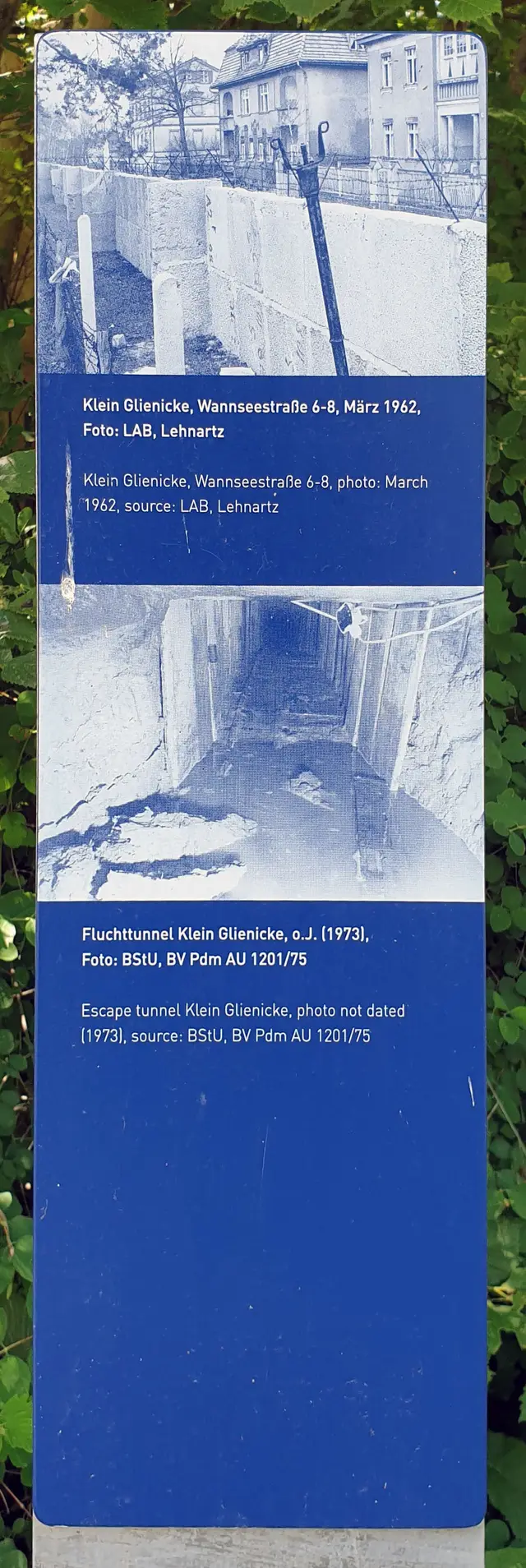
Ten years later, two families in Klein Glienicke, a piece of Potsdam almost surrounded by West Berlin, waited for a heatwave to lower the groundwater. With a child's shovel and a spade without a handle they dug 19 metres, and nine people, five of them children, came up just 80 centimetres beyond the Wall in July 1973. In the city centre, two brothers and a friend dug about 20 metres out of the sealed border cellar of an electricity company building on Zimmerstraße in January 1972.
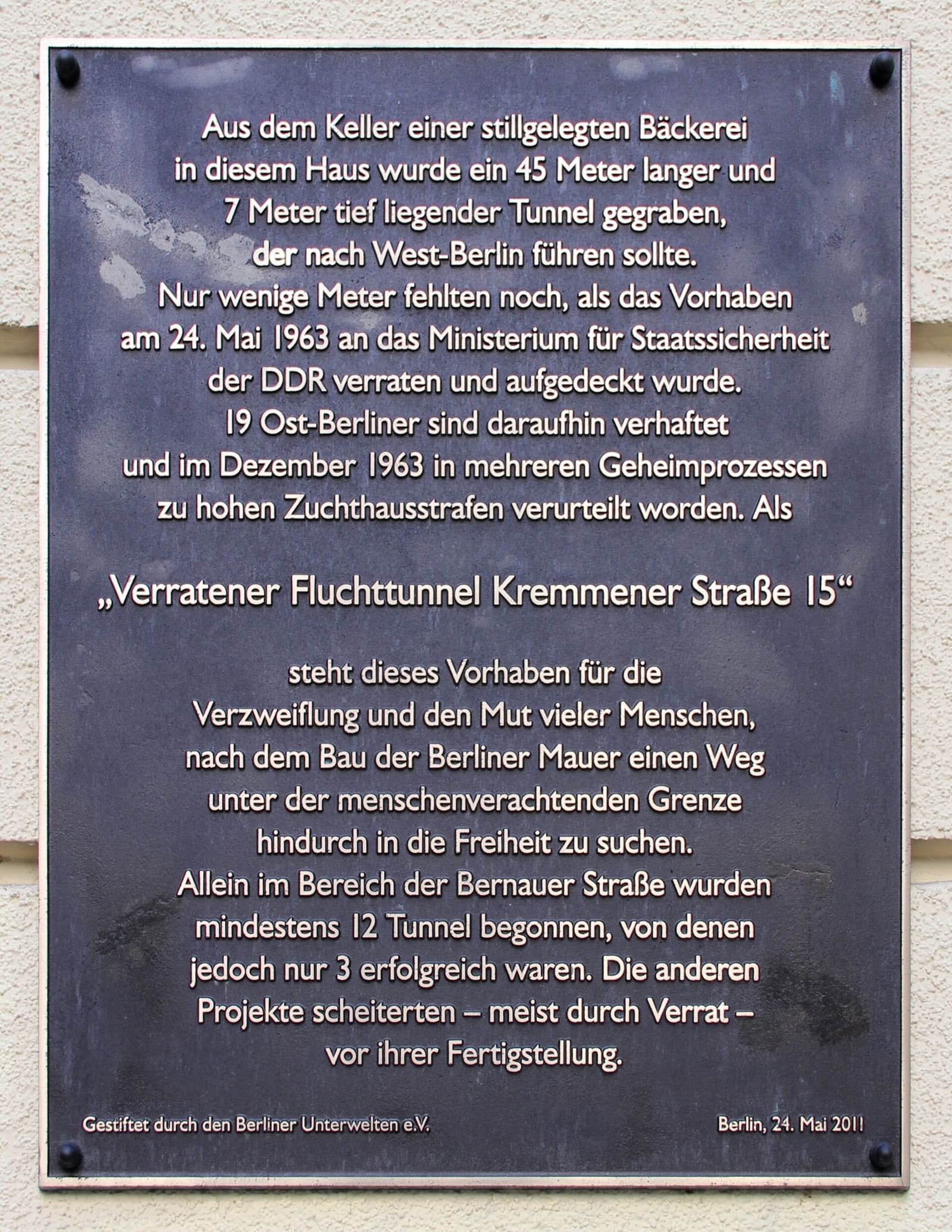
Digging out was risky in other ways. At Kremmener Straße 15, young East Berliners got to within a few metres of Bernauer Straße from a disused bakery cellar before the tunnel was discovered in May 1963. Nineteen people were jailed.
Digging in: the helpers' tunnels from the West
NARA's essay says most tunnels ran west to east because that was thought less dangerous.1 Digging started on safe ground, and only the last few metres, and the breakthrough, were in the East. The AP's 2009 report describes the diggers as often men who had already fled and were trying to get the rest of their families out.2 Many were students: the Girrmann group from the Free University, engineering students from the Technical University, and independent helpers such as Harry Seidel, a former cyclist.
1962 was the peak. About half of all known tunnels were attempted that year, according to NARA.1 The helpers learned by failing. A student tunnel under Wollankstraße S-Bahn station collapsed in January 1962, and the GDR showed it off at a press conference.
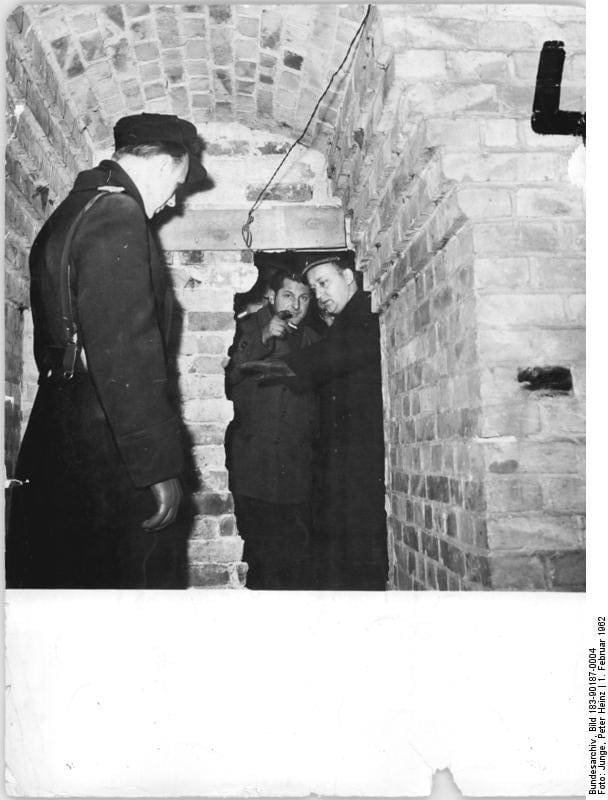
The brothers Boris and Eduard Franzke, who had dug at Wollankstraße, moved to Heidelberger Straße, where Neukölln and Treptow faced each other across a narrow street. Their first tunnel there was betrayed. In June 1962, Seidel's group dug the short Whitsun tunnel from a pub cellar in about three days. In April 1963, a second tunnel from Heidelberger Straße 35, only about 50 by 60 centimetres across, brought out up to 20 people; Boris Franzke crawled through it carrying a frightened mother's baby.
- Reached the West
- Some got through
- Stopped
- Killed
- Sewers5 · 11 reached the West3 reached the West · 1 some got through · 1 stopped
- Dug from the West by helpers12 · 92 reached the West5 reached the West · 2 some got through · 4 stopped · 1 killed
- Dug from the East by escapers7 · 65 reached the West5 reached the West · 2 stopped
- Direction not recorded6 · 23 reached the West1 reached the West · 1 some got through · 4 stopped
On this site's small sample, the family tunnels dug from the East succeed more often than the helpers' tunnels dug from the West. That fits the picture in the sources: the more people who knew about a tunnel, the easier it was to betray. NARA puts it as a security dilemma, since more diggers meant faster progress but a greater chance of the Stasi finding out.1 For more on the people who did this work, see the escape helpers.
Tunnel 29 and the television tunnel
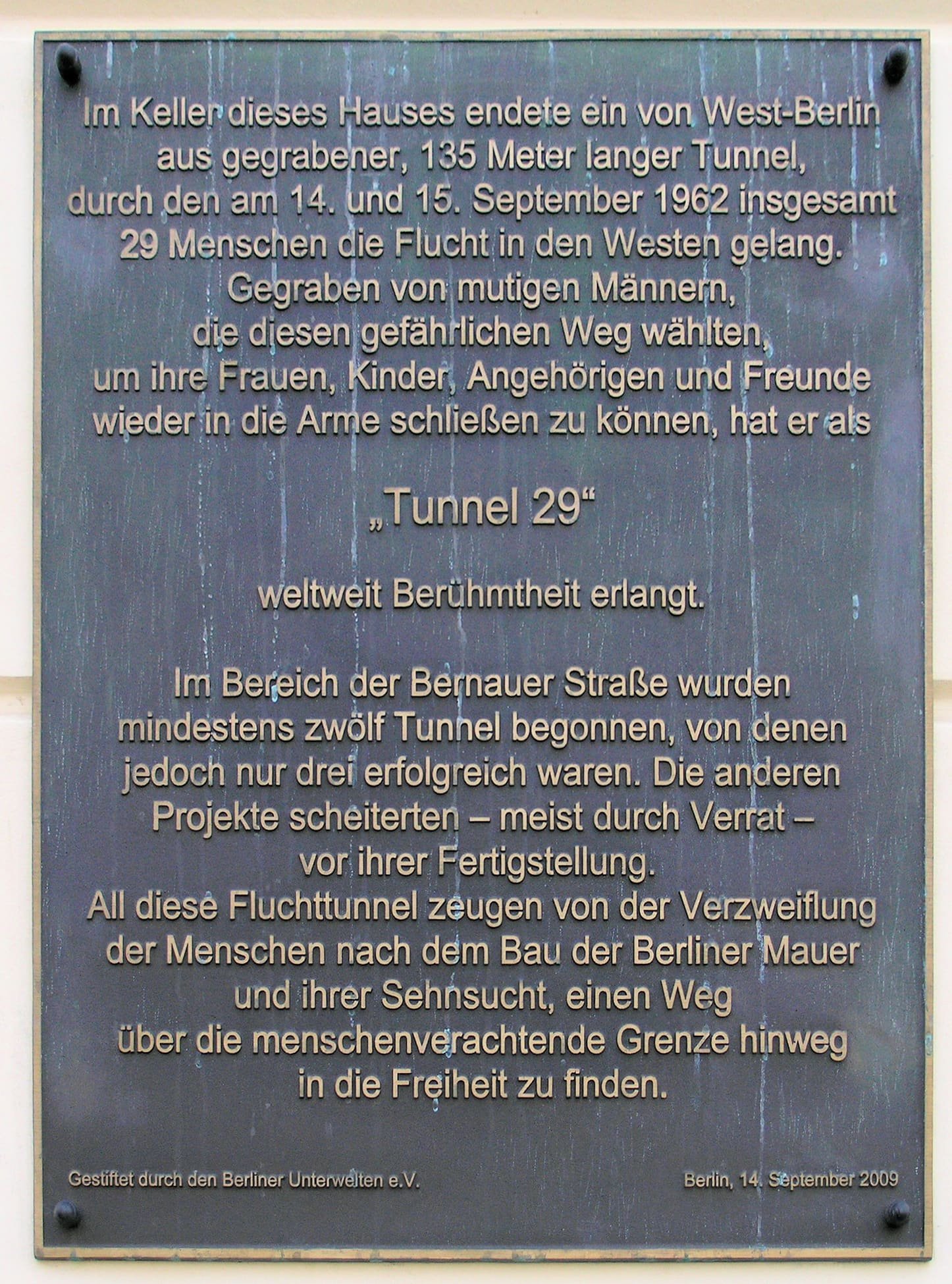
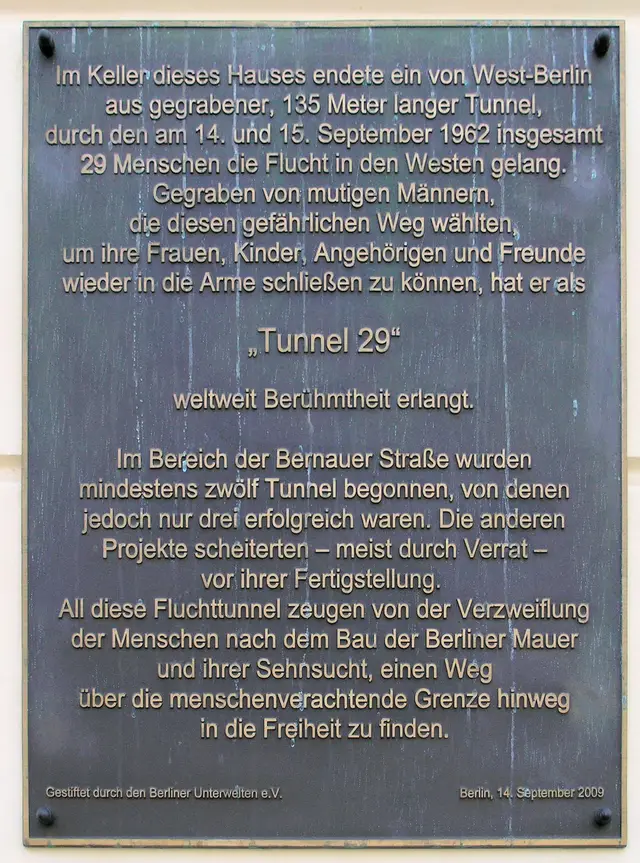
Tunnel 29 ran from a factory at Bernauer Straße 78/79 to the cellar of Schönholzer Straße 7. It was driven by engineering students, among them the Italians Luigi Spina and Domenico Sesta, Hasso Herschel, Ulrich Pfeifer and Joachim Rudolph.1 Herschel brought his own sister out through it. NARA describes the conditions: fifteen feet down, in sandy soil inside the water table. Although it was only three feet by three, the tunnel used some 20 tons of timber, and pumps removed 8,000 gallons of water a week.1 Its length is given as 120 metres (Chronik der Mauer), 126 metres (Der Spiegel in 1962), 135 metres (the plaque at Schönholzer Straße 7)12 or 140 yards (NARA).
The money came from American television, and the sums disagree:
- NBC News said in 2014 that the network agreed to finance the whole tunnel, paying 50,000 Deutschmarks for exclusive film rights, and that around $20,000 of its money went into building it.10
- The Conversation (2019) says NBC paid the diggers $7,500 for exclusive filming access, plus $5,000 if the escape worked.11
- NARA says Spina asked NBC's Berlin correspondent Piers Anderton for $50,000 and was bargained down to $12,000.1
NBC's documentary The Tunnel was due to air on 31 October 1962.10 With the Cuban missile crisis under way, the State Department tried to delay or stop it, and NBC held it back.1 10 11 It went out on 10 December 1962 to 13.5 million viewers and won three Emmys.11
CBS had a tunnel too. Its correspondent Daniel Schorr paid $1,250 for access to a different tunnel. When its diggers broke through in East Berlin, police were waiting.11 NARA's account of that night, 7 August 1962, matches the Kiefholzstraße tunnel on this site: Herschel and two friends escaped back down the tunnel, but 37 East Berliners waiting to go down were arrested, and 52 more participants after interrogations.1 Pressure from the US Mission and the Secretary of State had already kept Schorr away.1
The story reached a new audience in 2019 through Helena Merriman's BBC Radio 4 podcast Tunnel 29.
Betrayed: the tunnels the Stasi was waiting for
About a dozen of this site's tunnel records are tagged as betrayed or linked to an informer. The pattern repeats: a courier or a trusted contact reports to the Stasi, and an arrest squad waits for the breakthrough.
- Heidelberger Straße, March 1962. Dozens got out before the informer "IM Naumann" gave the tunnel away. Escape helper Heinz Jercha was hit by a ricochet in the ambush and died after crawling back to the West (the escape; Heinz Jercha on Victims of the Wall).
- Sebastianstraße, June 1962. West Berliners, among them Siegfried Noffke and Dieter Hötger, dug towards their wives and children. The Stasi had an informer in the group, and Siegfried Noffke was shot as they broke through (the escape; Siegfried Noffke).
- Kiefholzstraße, August 1962. About 80 people were meant to escape. A courier was a Stasi informer, and arrest figures range from 37 that night to about 90 in all (record).
- Kleinmachnow, November 1962. Harry Seidel climbed out into a garden to fetch refugees and was seized. He was sentenced to life imprisonment in a show trial and bought free by West Germany in 1966 (record).
- Bernauer Straße 78, February 1963. Tunnel 29's builders tried again from the same cellars. The diggers noticed the waiting Stasi officers in time, but 14 would-be escapees and three couriers were arrested.
Violence did not only come from one side. In June 1962 Rudolf Müller brought his family out through a tunnel to Zimmerstraße and shot the young border guard Reinhold Huhn. A German court later convicted him.
Tunnel 57
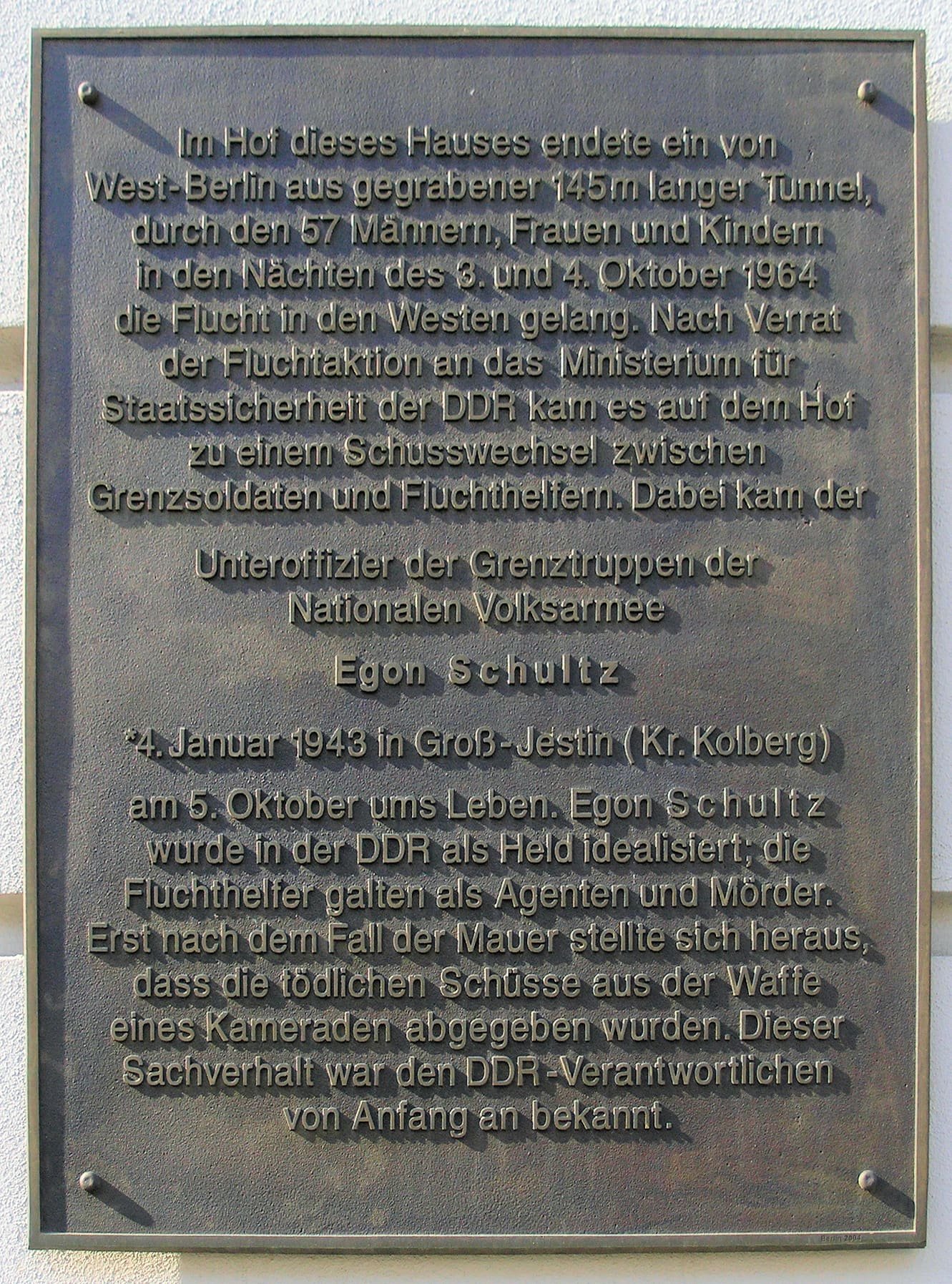
The biggest tunnel escape began in a disused bakery at Bernauer Straße 97. A first tunnel from the same cellar came up by mistake in a coal yard in view of the guards in January 1964; the Berlin Wall Foundation says three young women got through,6 though a Stasi report says no one had used it yet.
The second attempt went deeper, about twelve metres down.6 West Berlin students dug for half a year. The tunnel ran 145 metres, and 57 people escaped through it in October 1964,7 on the nights of 3 and 4 October (Tunnel 57). Figures vary a little here too: the Egon Schultz biography gives 11 metres, and the Irish Times gives a cross-section of just 1 metre by 80 centimetres.5
On the second night the plan was betrayed. Two Stasi men posing as refugees fetched border soldiers, and in the shooting in the courtyard of Strelitzer Straße 55 a helper wounded the guard Egon Schultz. The fatal shots came from a fellow soldier's Kalashnikov, as records showed only after 1990 (Tunnel 57; Egon Schultz). The GDR made Schultz a hero and blamed "West Berlin agents".
Why Bernauer Straße was honeycombed
The Berlin Wall Foundation counts at least ten escape tunnels on Bernauer Straße between 1962 and 1971, only three of them used successfully.6 On this site those three are Tunnel 29, the coal-yard tunnel and Tunnel 57. The AP, quoting Dietmar Arnold, spoke of at least 15 attempts,2 and Berliner Unterwelten counts seven tunnel projects along one 350-metre stretch alone.4
The street's layout explains much of it. The street itself was the border, and on the West Berlin side there were cellars in factories, tenements and a bakery, a short distance from houses in the East.
The ground is disputed. The 2009 AP report says the street was popular with diggers "due the high amount of clay in the soil".2 The Irish Times describes Berlin's soil as mostly sandy and unstable, with groundwater about three metres down.5 NARA says the soil at Tunnel 29 was sandy and "turned to butter" when wet.1 Both may be true in places, and this article does not pick one.
Figures: the Tunnel 57, Tunnel 71 and Tunnel 29 records and their sources; wall height from Chronik der Mauer, groundwater from The Irish Times.
The GDR learned to fight back underground. In 1970 the Stasi used listening probes to find a tunnel from Bernauer Straße 80, then dug a trench across its path when it was 85 metres long. Border troops also installed listening devices along Bernauer Straße. At Heidelberger Straße, in spring 1963, a trench about 2.5 metres deep made further tunnelling there impossible. In Glienicke, the border houses the Beckers and the Thomas group had dug from were torn down in 1963.
The last tunnels
After 1964 the tunnels thin out. After the 1970 attempt from Bernauer Straße 80, the next big project there was Tunnel 71, dug by Hasso Herschel and Ulrich Pfeifer, veterans of 1962.
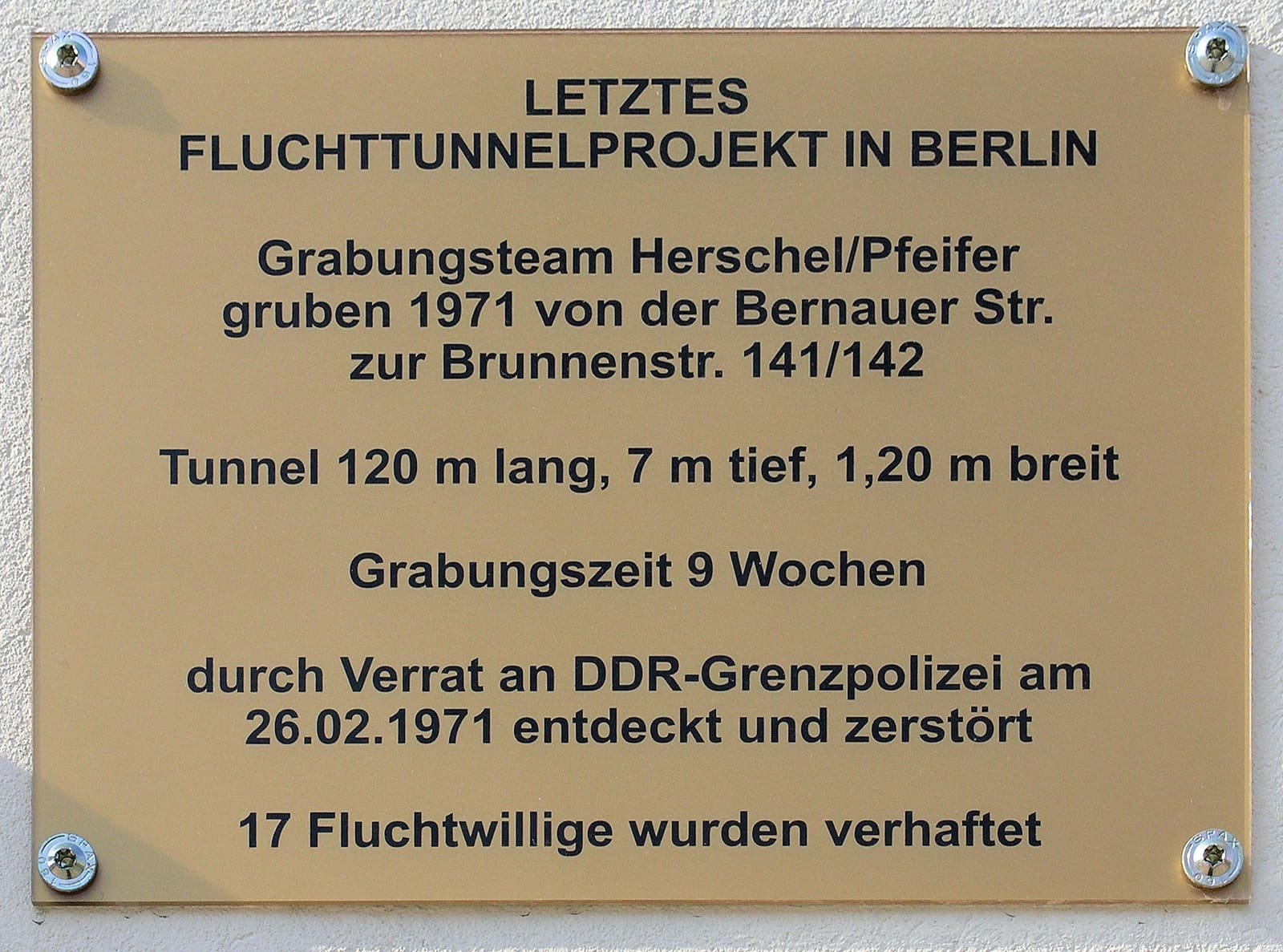
The sources disagree on its details. The plaque at Brunnenstraße 141 says the tunnel was 120 metres long, 7 metres deep and 1.20 metres wide, and took nine weeks. It says the tunnel was discovered through betrayal on 26 February 1971 and that 17 would-be escapees were arrested.9 The Berliner Zeitung, used in this site's record, gives about 115 metres planned, up to 9–10 metres deep and 90 centimetres high, and dates the discovery only to February 1971. The Irish Times says the tunnel was found 10 metres from the end and that several of the 17 people due to flee were arrested.5
The plaque calls it the last escape tunnel project in Berlin.9 The AP dated the tunnels from October 1961 to April 1982,2 and later ones did come. In January 1972 two brothers and a friend dug out of the BEWAG building on Zimmerstraße, in the city centre. In 1973 came the Klein Glienicke family tunnel. In 1981 a train driver and his wife dug 17 metres from their cellar at Sigridshorst near Teltow before giving up, with the border still several hundred metres away. The Stasi found the tunnel when it arrested them in April 1982.
Where to see a tunnel today
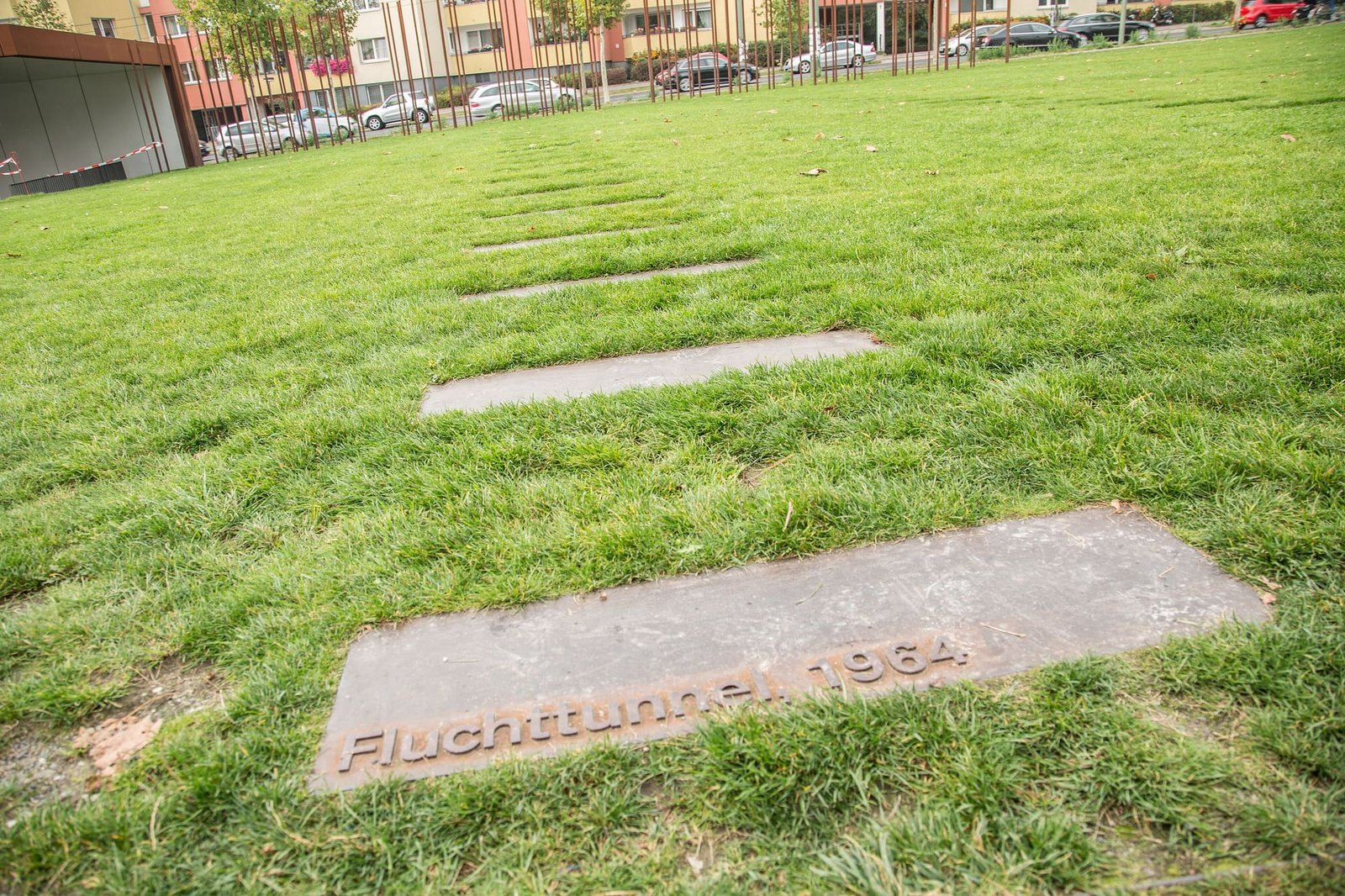
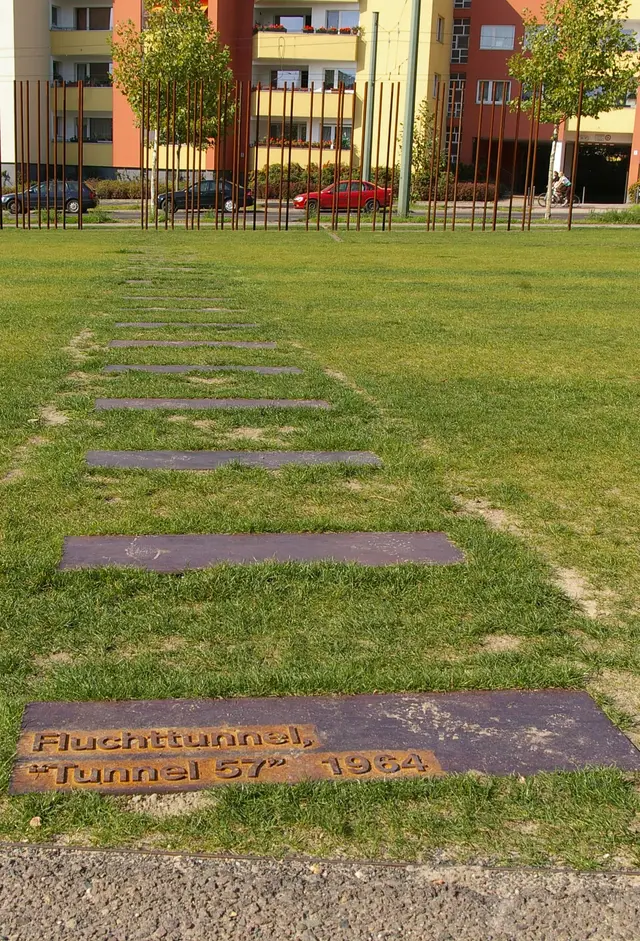
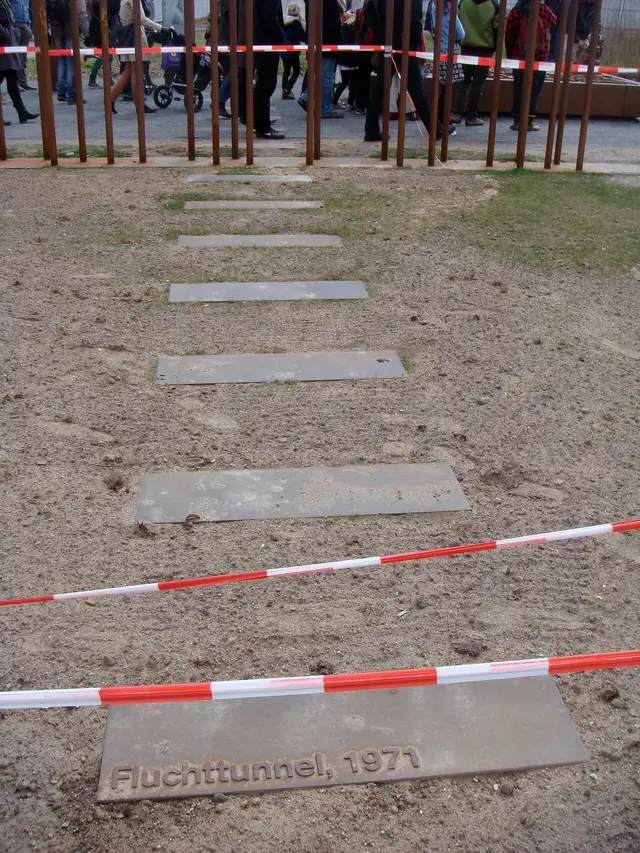
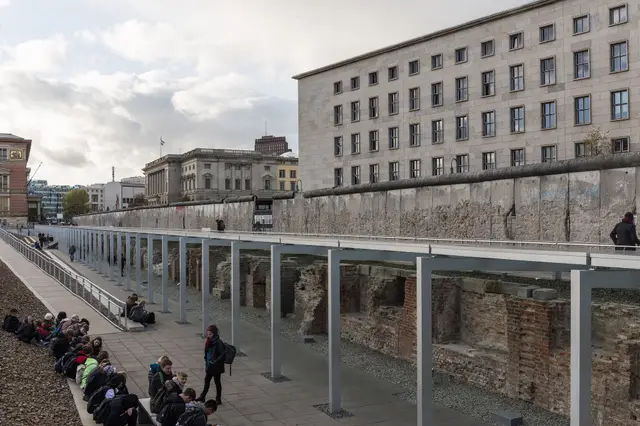
At the Berlin Wall Memorial on Bernauer Straße, steel plates in the grass show where two escape tunnels ran.6 Plaques mark other sites:
- Schönholzer Straße 7, the eastern end of Tunnel 29
- Strelitzer Straße 55, the eastern end of Tunnel 57, and Bernauer Straße 97, where both bakery tunnels began
- Brunnenstraße 141, for Tunnel 71
- Heidelberger Straße 35, for Heinz Jercha, and a ground plaque in front of Heidelberger Straße 81 for the Whitsun tunnel
- an information panel on Sebastianstraße for Siegfried Noffke
- Kremmener Straße 15, and a ground plaque at Zimmerstraße 9 for the 1972 tunnel
Only one original escape tunnel is still visible under the Wall, according to Berliner Unterwelten. Its "Under the Berlin Wall" tour starts at Brunnenstraße 141 and runs for 90 minutes in the vaults of the former Oswald brewery, with original photos, exhibits and full-size tunnel replicas. Children under seven are not admitted, and the association recommends it only from age 14.4 Since 2019 a new visitor tunnel crosses the 1971 tunnel, so part of it can be seen.5
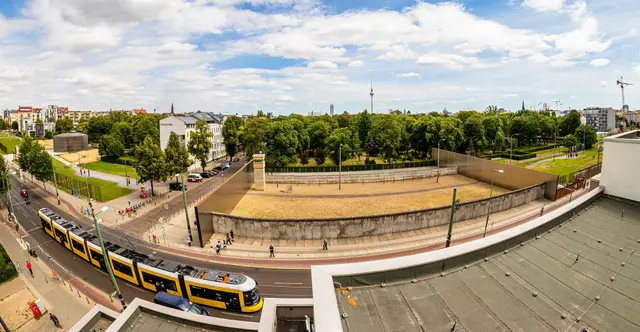
Most of these places lie on one walk. For a route that links them with other escape sites, see the escape sites walking tour; for the ideas that did not involve digging, see the most ingenious escapes.
Questions and answers
- How many tunnels were dug under the Berlin Wall?
- Published totals range from about 70 to 75. The US National Archives, citing Arnold and Kellerhoff (2008), counts 70 known tunnels, of which 19 are believed to have succeeded; Dietmar Arnold of Berliner Unterwelten spoke of 71 tunnel projects in 2009; the association's tour page now says 75. Secrecy means some attempts were never recorded.
- How many people escaped through tunnels under the Berlin Wall?
- Estimates range from at least 209 (US National Archives) through about 300 (the Associated Press in 2009, the Irish Times in 2019) and more than 300 (Bundesstiftung Aufarbeitung) to up to 450 (Berliner Unterwelten). The biggest tunnel escape with a firm count was Tunnel 57, with 57 people in October 1964.
- What was Tunnel 57?
- A tunnel dug by West Berlin students from a disused bakery at Bernauer Straße 97 to a courtyard at Strelitzer Straße 55. It was about 145 metres long and up to 12 metres deep, and 57 people escaped through it on 3–4 October 1964. Border guard Egon Schultz was killed in a shoot-out on the second night; the fatal shots came from a fellow GDR soldier.
- Why were so many tunnels dug at Bernauer Straße?
- The street itself was the border, with cellars, factories and a bakery on the West Berlin side close to houses in the East. Sources disagree on the ground: an AP report of 2009 credits clay in the soil, while the Irish Times and the US National Archives describe sandy, unstable soil with groundwater about three metres down.
- Can you still see a Berlin Wall escape tunnel?
- Yes. Berliner Unterwelten's 'Under the Berlin Wall' tour, starting at Brunnenstraße 141, shows a section of the 1971 tunnel, which the association calls the only original escape tunnel still visible under the Wall. At the Berlin Wall Memorial, steel plates in the grass mark the course of escape tunnels.
Sources
- Donald P. Steury, 'Tunneling to Freedom' (citing Arnold & Kellerhoff, Die Fluchttunnel von Berlin, 2008)US National Archives (NARA)
- Tours of tunnels mark Berlin Wall history (13 Oct 2009)Associated Press via NBC News
- Themendossier: Flucht, Fluchthilfe und FreikaufBundesstiftung zur Aufarbeitung der SED-Diktatur, Zeitzeugenbüro
- Under the Berlin Wall (tour M)Berliner Unterwelten e.V.
- Derek Scally, 'Reopened tunnel under Berlin Wall holds history of hope and despair' (10 Nov 2019)The Irish Times
- Tunnel escapes on Bernauer Straße (digital tour guide)Stiftung Berliner Mauer
- Mass escape tunnel 57 at Bernauer Straßerbb, The Berlin Wall – history in pictures
- Tunnel Escape from East to West Berlin (January 24, 1962)German History in Documents and Images (GHI Washington)
- Plaque 'Letztes Fluchttunnelprojekt in Berlin', Brunnenstraße 141 (photo, 2010)Wikimedia Commons (OTFW)
- Tunnel 29: How NBC News Funded Big Breach of Berlin Wall (7 Nov 2014)NBC News
- Mike Conway, 'The battle between NBC and CBS to be the first to film a Berlin Wall tunnel escape' (8 Nov 2019)The Conversation
- Memorial plaque for Tunnel 29 at Schönholzer Straße 7 (photograph, 2010)Wikimedia Commons (OTFW)
Facts taken from an escape record on this site link to that record, which lists its own sources.
Spotted an error, or know more? Email us a correction or addition
Escapes in this article
3 October 1964 – 5 October 1964
Tunnel 57
57 East Berliners crawled through a 145-metre tunnel dug by West Berlin students under Bernauer Straße. The escape ended in a shoot-out in which border guard Egon Schultz was killed; records opened after 1990 showed the fatal shots came from a fellow GDR soldier.
14 September 1962 – 15 September 1962
Tunnel 29
Around 30 helpers, mostly students, dug a tunnel from a factory on Bernauer Straße to a cellar in East Berlin; 29 people escaped through it over two days while an American TV crew filmed.
24 January 1962
The Becker Tunnel ("Tunnel 28")
Twin brothers dug a tunnel from the cellar of the family home on the border, and 28 people crawled through it to Frohnau in West Berlin in a single night.
5 May 1962
The Pensioners' Tunnel (Thomas Tunnel)
A group of mostly elderly men led by 81-year-old Max Thomas dug an unusually tall tunnel from a chicken coop so that they and their wives could walk upright to West Berlin.
10 March 1963
The Aagaard Tunnel
A family in Glienicke spent five months digging a 50-metre tunnel by hand from their living room, hiding the sand inside their house, before 13 people crawled to West Berlin.
7 August 1962
The Betrayed Kiefholzstraße Tunnel
Several escape-helper groups joined forces on a tunnel to a small house on Kiefholzstraße for a planned mass escape, but a Stasi informer among the couriers betrayed it and dozens of would-be refugees were arrested.
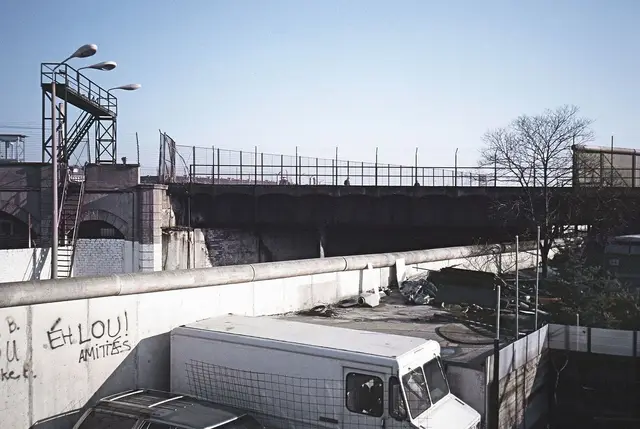
February 1971
Tunnel 71 – The Last Tunnel under Bernauer Straße
Hasso Herschel's team lived underground for nine weeks digging a tunnel beneath Bernauer Straße, but came within ten metres of their goal before GDR border troops dug it up.
26 July 1973
The Klein Glienicke Family Tunnel
Two brothers, their wives and five children escaped from the GDR exclave of Klein Glienicke through a 19-metre tunnel dug with a child's spade during a heatwave.
More articles
The numbers
How Many People Escaped the Berlin Wall?
The figure of 5,075 comes from a West Berlin police count. Here is where it comes from, how it fell year by year, and what several hundred documented escapes add to it.
How they did it
The Most Ingenious Berlin Wall Escapes, and How They Worked
A cable from a ministry roof, a train that didn't stop, a bubble car with a person behind the seat. Eleven escapes that were engineered rather than lucky, with the measurements and the places the sources disagree.
Walking tour
Walking the Berlin Wall Escape Routes: A Self-Guided Tour
Two walks and two short add-ons, built from the dated escapes on this site. Each stop says what happened within a few hundred metres, what you can still see there, and how far it is to the next one.