10 March 1963 · Tunnels · Glienicke/Nordbahn, Frohnau and Bergfelde
The Aagaard Tunnel
A family in Glienicke spent five months digging a 50-metre tunnel by hand from their living room, hiding the sand inside their house, before 13 people crawled to West Berlin.
The Aagaard family lived at Ottostraße 7 in Glienicke/Nordbahn, with the border to Hermsdorf in West Berlin right at their garden fence. Fearing forced resettlement, they decided in summer 1962 to dig a tunnel together with friends from Dresden.
Digging began on 5 October 1962 beneath the terrace door of the living room. With no cellar, the family built false walls and ceilings and hid about 25 cubic metres of sand in them, as well as in drawers, gutters, cupboards and bathtubs. Lucie Aagaard even expanded her hairdressing salon to give the impression that the family meant to stay.
The breakthrough to Veltheimstraße came on 8 March 1963, after about 50 metres had been dug, mostly by hand. On the night of 9–10 March 1963 (the Berliner Zeitung says 10–11 March), 13 people went through the tunnel; the 70-year-old grandmother was pulled along on an air mattress. They waited at the exit until West Berlin police arrived, and were out by 4 a.m. The escape was only noticed when customers queued outside the empty salon on Monday morning.
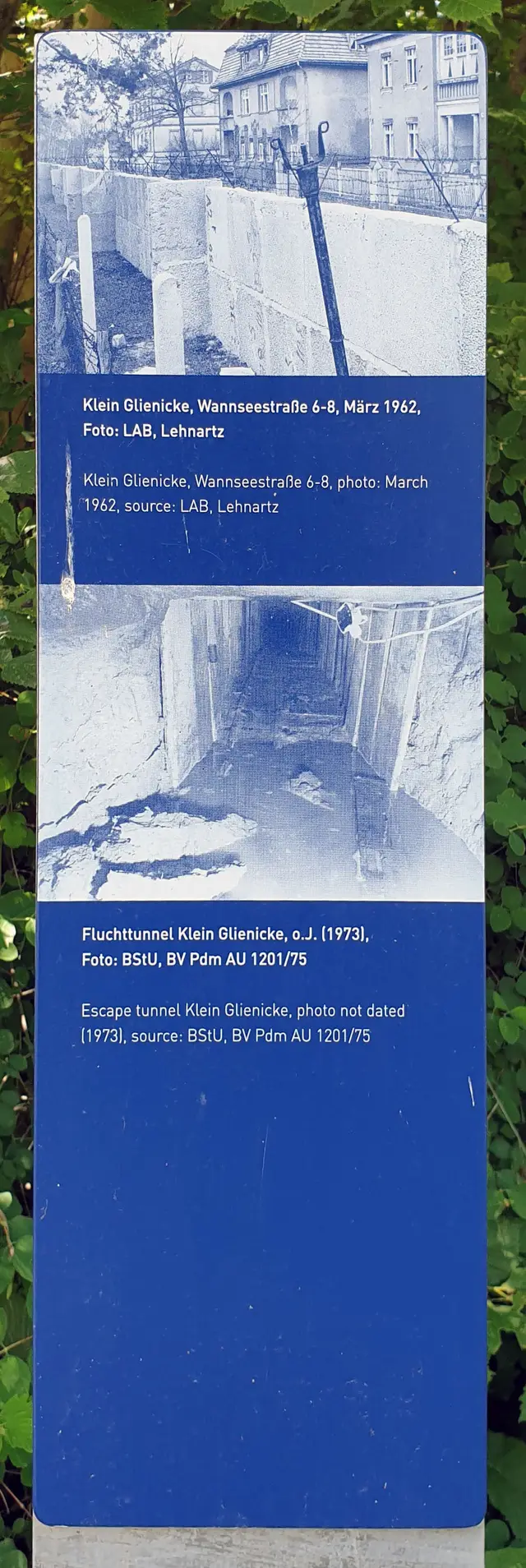
The tunnel was archaeologically excavated in 2011.
Where the accounts differ
The sources do not tell this story the same way. We give each version with its source rather than choose one; the summary and map follow the best-supported version.
Which night they went through
- The night of Saturday 9 to Sunday 10 March 1963Fluchttunnel Glienicke (Archäologiebüro ABD-Dressler) (historian or memorial)
- The night to 10 March 1963Bundesstiftung zur Aufarbeitung der SED-Diktatur (Orte des Erinnerns) (historian or memorial)
- The night of 10 to 11 March 1963Berliner Zeitung (press)
The first two describe the same night (9 to 10 March).
How much sand was hidden in the house
- 25 cubic metresFluchttunnel Glienicke (Archäologiebüro ABD-Dressler) (historian or memorial)
- 75 cubic metres, by Detlef Aagaard's own later reckoningBerliner Zeitung (press)
Sources
Whose account is this? Drawn from a press report, a witness account and historical research.
Press
Witness accounts
- Der versteckte Sandrbb – Geschichte der Berliner Mauer (berlin-mauer.de)
Historians and memorials
- Der Aagaard-TunnelFluchttunnel Glienicke (Archäologiebüro ABD-Dressler)
- Erinnerungsstele „Aagaard-Tunnel“Bundesstiftung zur Aufarbeitung der SED-Diktatur (Orte des Erinnerns)
Facts checked against the sources: November 2026
Spotted an error, or know more about this story? Email us a correction or addition
Cite this page
Berlin Experiences, “The Aagaard Tunnel”, Berlin Wall Escapes, 2026, https://berlinwallescapes.com/escapes/aagaard-tunnel-glienicke-1963/ (accessed [date]).
Related escapes
5 May 1962
The Pensioners' Tunnel (Thomas Tunnel)
A group of mostly elderly men led by 81-year-old Max Thomas dug an unusually tall tunnel from a chicken coop so that they and their wives could walk upright to West Berlin.
24 January 1962
The Becker Tunnel ("Tunnel 28")
Twin brothers dug a tunnel from the cellar of the family home on the border, and 28 people crawled through it to Frohnau in West Berlin in a single night.
8 April 1963
A second tunnel from Heidelberger Straße 35 – Boris Franzke's last
A year after Heinz Jercha was shot at the same spot, escape helpers dug a new tunnel from Heidelberger Straße 35 to no. 75. Up to 20 people escaped through it before a resident noticed the broken cellar door.
26 July 1973
The Klein Glienicke Family Tunnel
Two brothers, their wives and five children escaped from the GDR exclave of Klein Glienicke through a 19-metre tunnel dug with a child's spade during a heatwave.