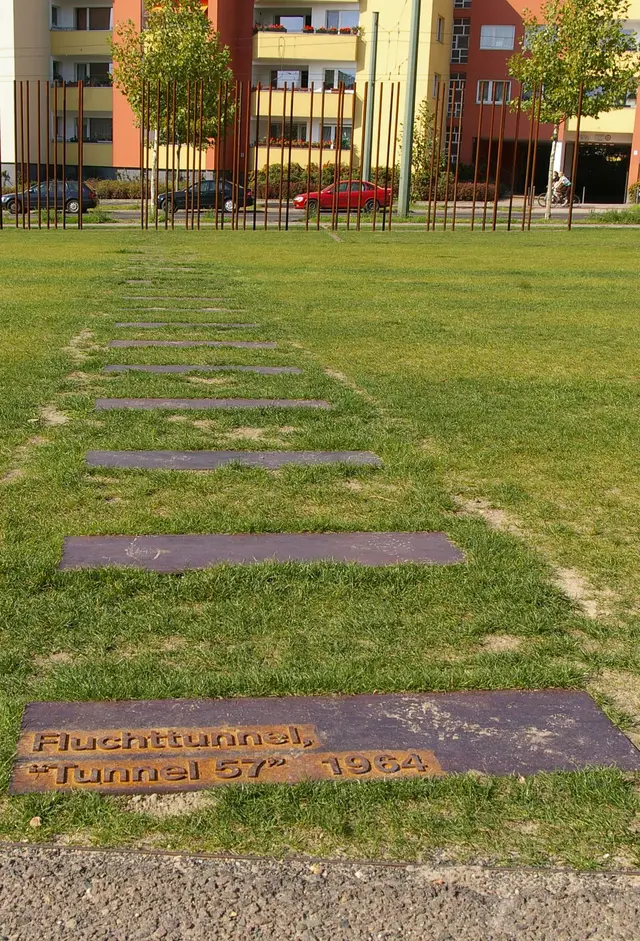
February 1971 · Tunnels · Bernauer Straße
Tunnel 71 – The Last Tunnel under Bernauer Straße
Hasso Herschel's team lived underground for nine weeks digging a tunnel beneath Bernauer Straße, but came within ten metres of their goal before GDR border troops dug it up.
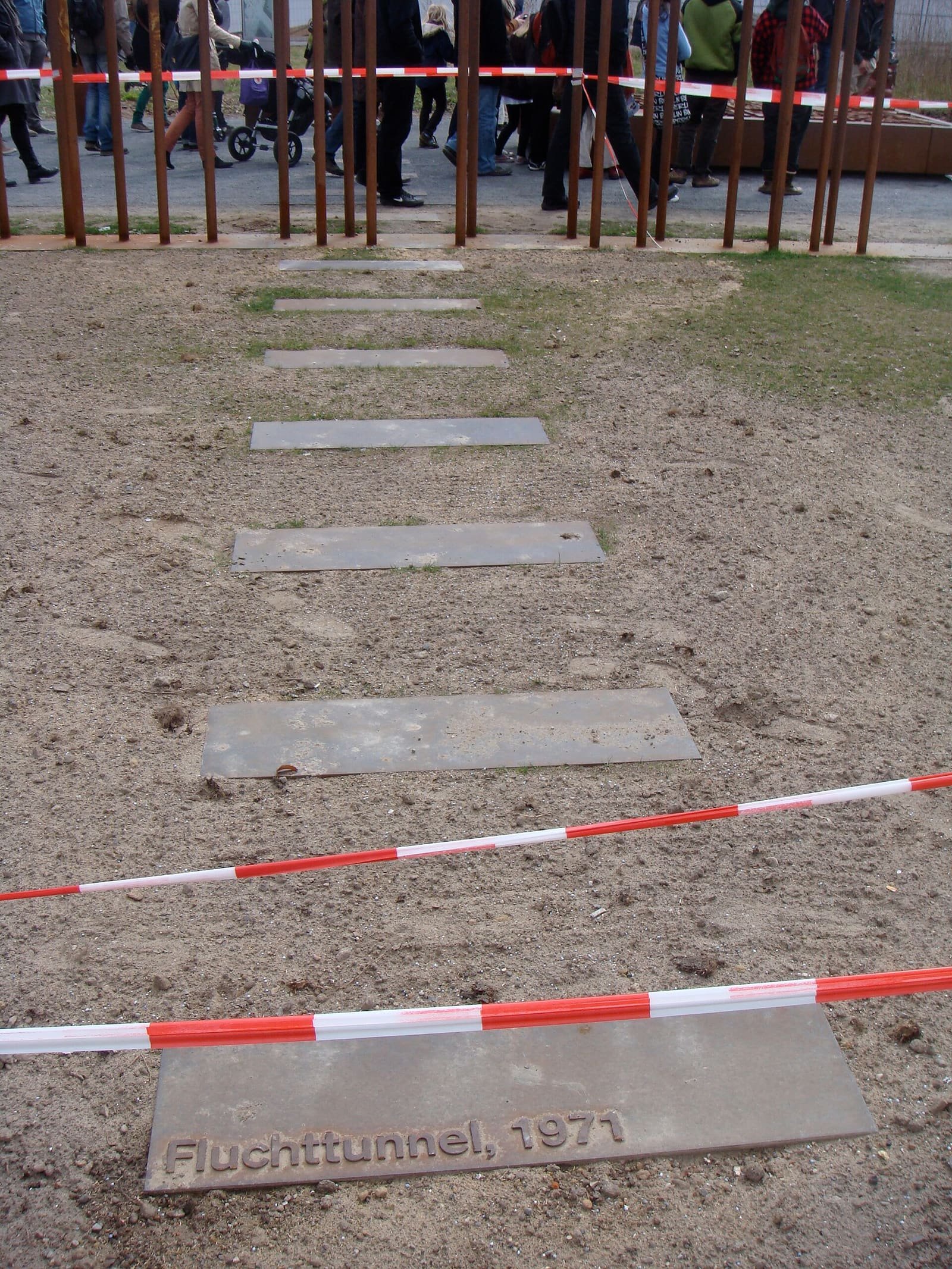
In late 1970 Hasso Herschel started a new tunnel with six friends from the tenement at Brunnenstraße 137 in West Berlin. Civil engineer Ulrich Pfeifer handled the surveying. The tunnel, up to nine or ten metres deep according to the Berliner Zeitung, was planned to run about 115 metres under Bernauer Straße and the border strip to Brunnenstraße 141 in East Berlin, where 17 East Germans were to escape. The two memorial plaque texts give the target as Brunnenstraße 142 and 141/142, and other figures for its size.
Instead of sinking a vertical shaft, the helpers dug a sloping ramp to make removing the spoil easier. For security, no one left the site during the roughly nine weeks of work; the diggers lived in the tunnel.
In February 1971, only about ten metres from the target, an excavator of the border troops appeared in the death strip and began digging exactly where the tunnel ran. The helpers withdrew. The tunnel was dug out and mostly filled with concrete. Accounts differ on how it was found: according to the Berliner Zeitung, Herschel and Pfeifer know from Stasi files that an informer probably betrayed the project, and the border troops had also installed listening devices in the ground along Bernauer Straße; Pfeiffer told the Irish Times he believes special ultrasonic microphones gave it away. The plaque at Brunnenstraße 141 says 17 would-be escapees were arrested; the other plaque text and the Irish Times say several of the 17.
The association Berliner Unterwelten rediscovered the tunnel with laser measurements and, in 2019, opened a visitor tunnel that crosses it, making a section of the original escape tunnel visible.
Where the accounts differ
The sources do not tell this story the same way. We give each version with its source rather than choose one; the summary and map follow the best-supported version.
Where the tunnel was to come out
- At Brunnenstraße 141 in the East: the tunnel was to run from the tenement Brunnenstraße 137 in the West, under Bernauer Straße, 'zur Brunnenstraße 141 im Ostteil'.Berliner Zeitung (press)
- At Brunnenstraße 142: the plaque text in the Mitte plaque database has the group dig 'vom Keller der Brunnenstraße 137 einen Tunnel zur Brunnenstraße 142', passing under the building that bears the plaque (no. 141).Bezirksamt Mitte, Gedenktafel-Datenbank (historian or memorial)
- At Brunnenstraße 141/142, according to the memorial plaque on no. 141.Wikimedia Commons (OTFW) (historian or memorial)
The map point is no. 141, where the plaque hangs; today's no. 142 stands about 20 m further south (Geoportal Berlin).
How many would-be escapees were arrested
- "17 Fluchtwillige wurden verhaftet" (17 would-be escapees were arrested), on the plaque at Brunnenstraße 141.Wikimedia Commons (OTFW) (historian or memorial)
- Several of the 17 people who had already been told were arrested ("Mehrere der 17 bereits benachrichtigten fluchtwilligen Personen werden in diesem Zusammenhang verhaftet").Bezirksamt Mitte, Gedenktafel-Datenbank (historian or memorial)
- Several of the 17 people scheduled to flee through the tunnel were arrested and served prison time.The Irish Times (Derek Scally, 10 Nov 2019) (press)
Size of the tunnel
- Planned at 115 metres long and 90 centimetres high; Herschel says they worked up to nine metres underground (the article also says up to ten metres below the death strip).Berliner Zeitung (press)
- About 115 metres planned, about 105 metres reached, more than 9 metres below ground, up to 1.20 metres high and 90 centimetres wide.Bezirksamt Mitte, Gedenktafel-Datenbank (historian or memorial)
- "Tunnel 120 m lang, 7 m tief, 1,20 m breit" (120 m long, 7 m deep, 1.20 m wide).Wikimedia Commons (OTFW) (historian or memorial)
How it was discovered
- Herschel and Pfeifer know from Stasi files that the project was probably betrayed by an informer close to the helpers; the head of Berliner Unterwelten adds that the border troops had built a microphone system into the ground of the death strip.Berliner Zeitung (press)
- Betrayed to the GDR border police ("durch Verrat an DDR-Grenzpolizei am 26.02.1971 entdeckt und zerstört").Wikimedia Commons (OTFW) (historian or memorial)
- Pfeiffer believes it was discovered with special ultrasonic microphones that could pick up the sound of shovels.The Irish Times (Derek Scally, 10 Nov 2019) (press)
The berlin.de plaque text also says the tunnel was betrayed, to the Stasi ("an die DDR-Staatssicherheit verraten").
Sources
Whose account is this? Drawn from press reports and historical research.
Press
- Berliner Unterwelten-Verein: DDR-Fluchttunnel unter der Bernauer Straße wiederentdecktBerliner Zeitung
- Besuchertunnel in Mitte eröffnet: DDR-Fluchttunnel kann jetzt besichtigt werdenDer Tagesspiegel
- 'It was gut-wrenching': Berlin Wall tunneller recalls 1971 captureThe Guardian
- Reopened tunnel under Berlin Wall holds history of hope and despairThe Irish Times (Derek Scally, 10 Nov 2019)
- Tunnel einen Tag vor Fluchtversuch entdeckt (Honnefer Volkszeitung, 1971-02-26, p. 1)Honnefer Volkszeitung, via Deutsche Digitale Bibliothek (Zeitungsportal)
Historians and memorials
- Memorial plaque at Brunnenstraße 141 (photograph, 2010)Wikimedia Commons (OTFW)
- Letztes Fluchttunnelprojekt an der Bernauer Straße (plaque text)Bezirksamt Mitte, Gedenktafel-Datenbank
Facts checked against the sources: November 2026
Spotted an error, or know more about this story? Email us a correction or addition
Cite this page
Berlin Experiences, “Tunnel 71 – The Last Tunnel under Bernauer Straße”, Berlin Wall Escapes, 2026, https://berlinwallescapes.com/escapes/tunnel-71-brunnenstrasse/ (accessed [date]).
Related escapes
7 August 1962
The Betrayed Kiefholzstraße Tunnel
Several escape-helper groups joined forces on a tunnel to a small house on Kiefholzstraße for a planned mass escape, but a Stasi informer among the couriers betrayed it and dozens of would-be refugees were arrested.
14 September 1962 – 15 September 1962
Tunnel 29
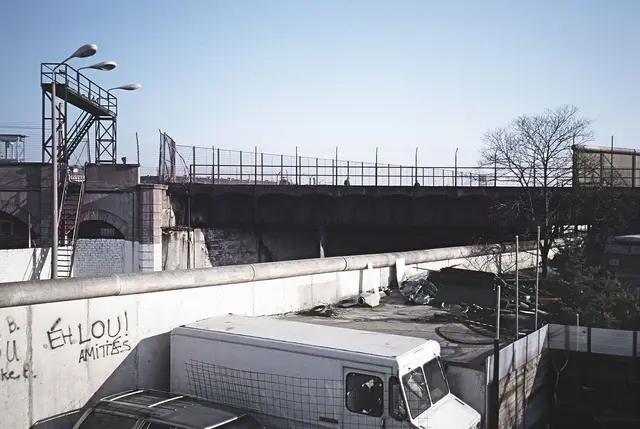
Around 30 helpers, mostly students, dug a tunnel from a factory on Bernauer Straße to a cellar in East Berlin; 29 people escaped through it over two days while an American TV crew filmed.
February 1963
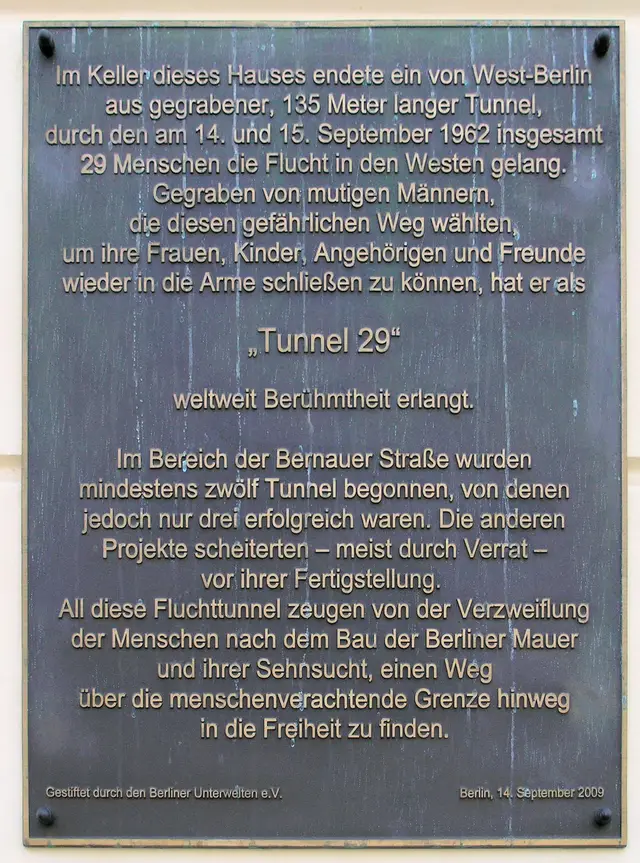
The betrayed second tunnel from Bernauer Straße 78
Tunnel 29's builders dug again from the same cellars; on breakthrough day Stasi officers lay in wait at Brunnenstraße 45. The diggers noticed in time, but 14 would-be escapees and three couriers were arrested.
3 October 1964 – 5 October 1964
Tunnel 57
57 East Berliners crawled through a 145-metre tunnel dug by West Berlin students under Bernauer Straße. The escape ended in a shoot-out in which border guard Egon Schultz was killed; records opened after 1990 showed the fatal shots came from a fellow GDR soldier.