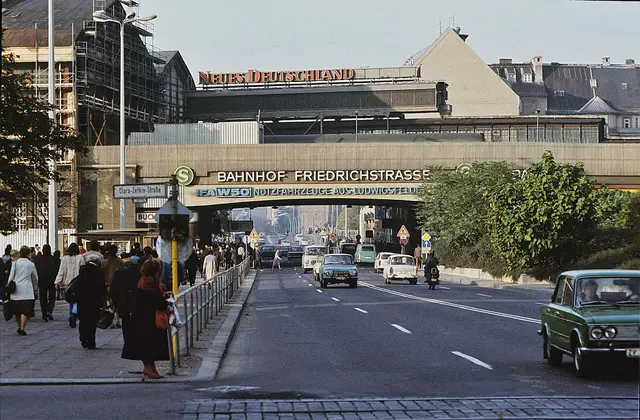
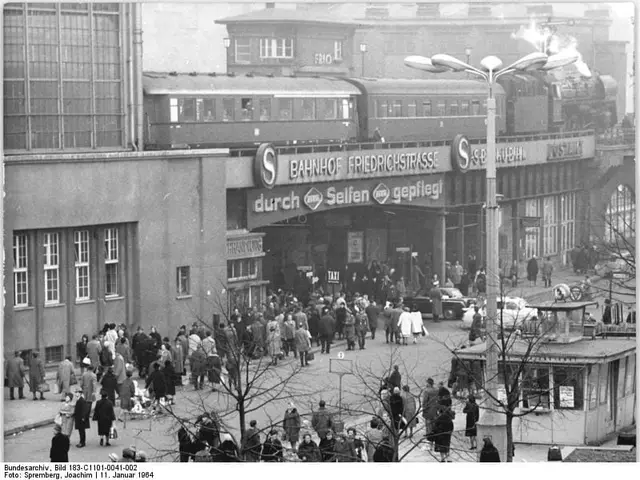
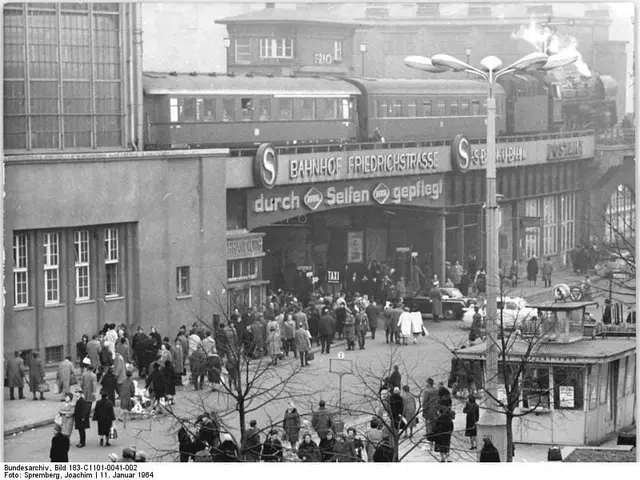
Friedrichstraße station
The East Berlin station where trains, S-Bahn and U-Bahn lines from the West met the border controls.
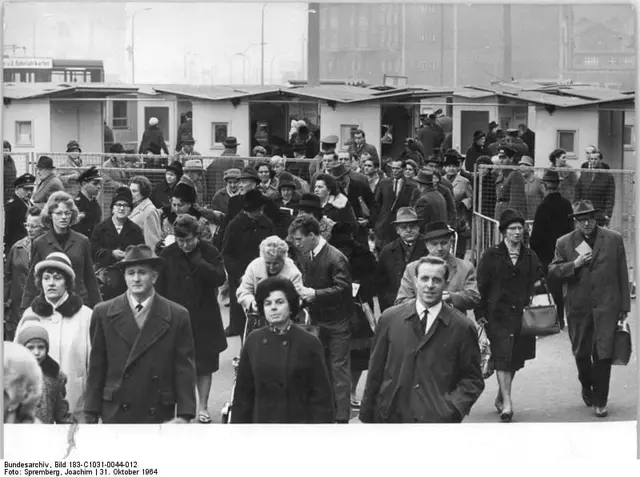
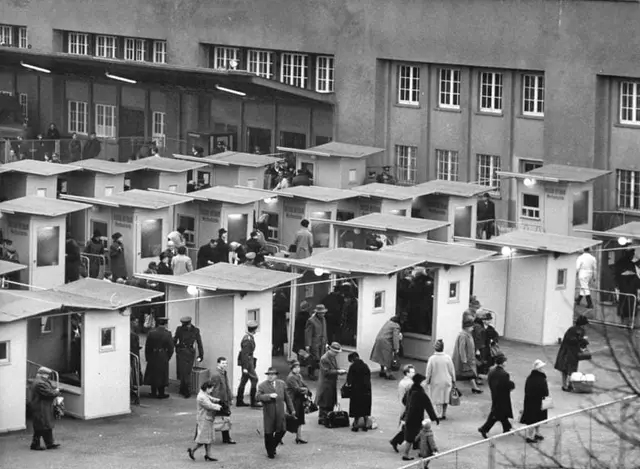
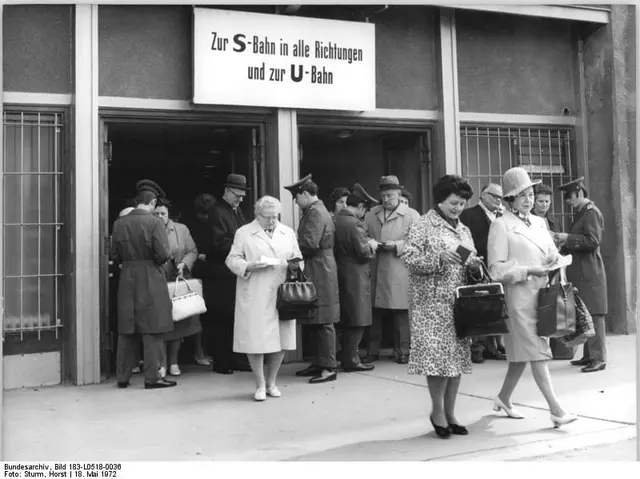
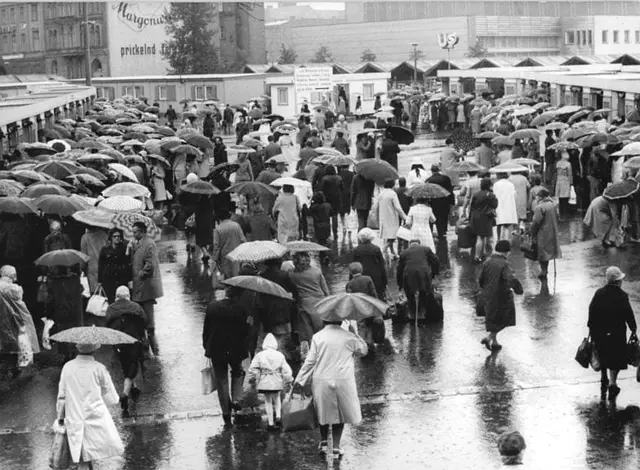
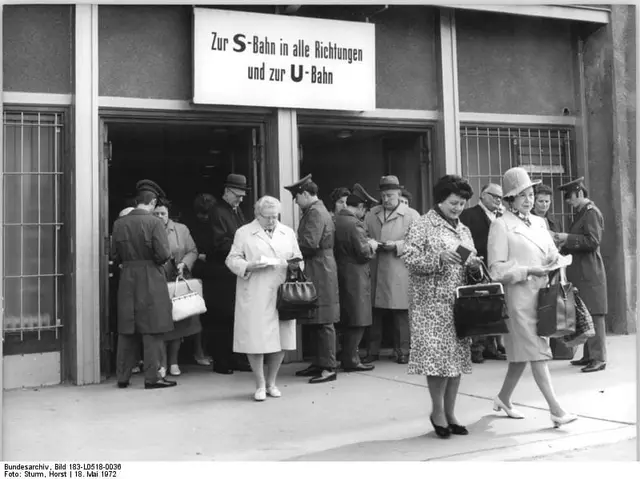
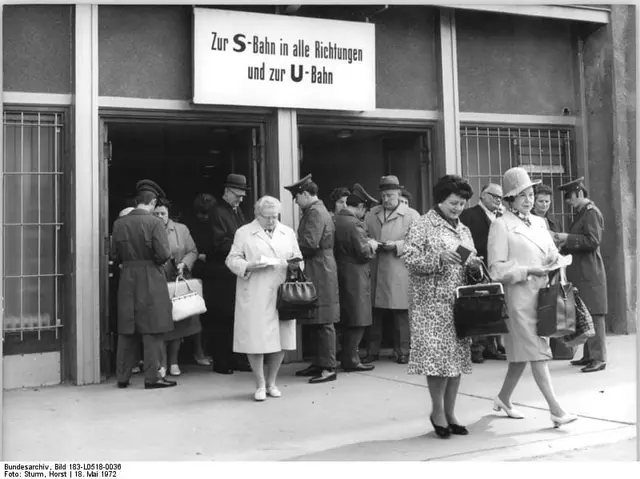
Friedrichstraße was a border station in the middle of the city. GDR citizens could use the entrance hall and the southern platform. Travellers from the West came in through a separate hall, the Tränenpalast, to reach the two northern platforms and the underground north–south line, and the same route was the way out for GDR pensioners. Underneath lay passages, one-way mirrors and cameras, and the platforms were divided first by a wire-glass wall about three metres high and, from 1982, by a soundproof steel wall the height of the hall.1
So the records here are about papers and partitions rather than fences. Joachim Neumann dyed his hair to match a Swiss passport and passed the control in December 1961; in 1964 someone left on a Danish woman's passport fifteen minutes before she reported it missing. The same year two young men cut the padlock off the lift to the westbound platform, one posing as a frail wheelchair user, and rode to Bahnhof Zoo. In 1965 a grille beneath the glass wall was cut so that a girlfriend could slip through; in 1969 a man kicked in a glass panel of the partition and was arrested on the next train. The Stasi officer Werner Stiller used his service's own gate to the U-Bahn platform in 1979. In 1974 the Pole Czesław Kukuczka was given an exit visa, brought here and shot in the back during clearance, and in 1983 a hijacked S-Bahn stopped with two and a half carriages inside the border section.
An essay on the Chronik der Mauer notes that little of the divided station is left apart from the patrol walkways at its western end.1 The Tränenpalast, the separate hall that travellers to the West passed through, now holds a permanent exhibition of the Haus der Geschichte, "Ort der deutschen Teilung" (a place of German division), with free entry.2
Sources for this text
- Bahnhof Friedrichstraße: Ein Museum der ErinnerungenChronik der Mauer
- TränenpalastStiftung Haus der Geschichte der Bundesrepublik Deutschland
Checked October 2026. Facts taken from an escape record on this site link to that record, which lists its own sources.
13 events: 6 successful escapes, 2 partly successful escapes, 4 failed attempts and 1 fatal attempt. At least 15 people reached the West in these events.
6 October 1961
Sewer escape helper Carl-August von Halle walks into a Stasi trap
A West Berlin architecture student who had helped East Germans escape through the sewers was lured into a trap by a Stasi informer and arrested at Friedrichstraße station.
21 December 1961
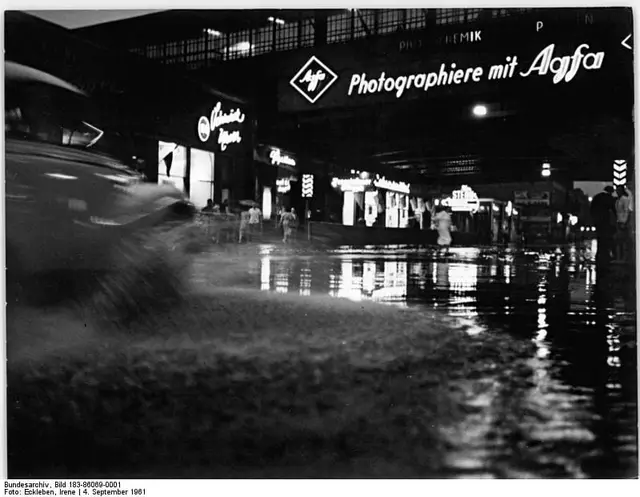
Joachim Neumann's Swiss passport
Engineering student Joachim Neumann dyed his hair, filled his pockets with Swiss odds and ends and played an aloof Swiss tourist to pass the Friedrichstraße checkpoint on a Swiss passport supplied through West Berlin student escape helpers.
January 1964
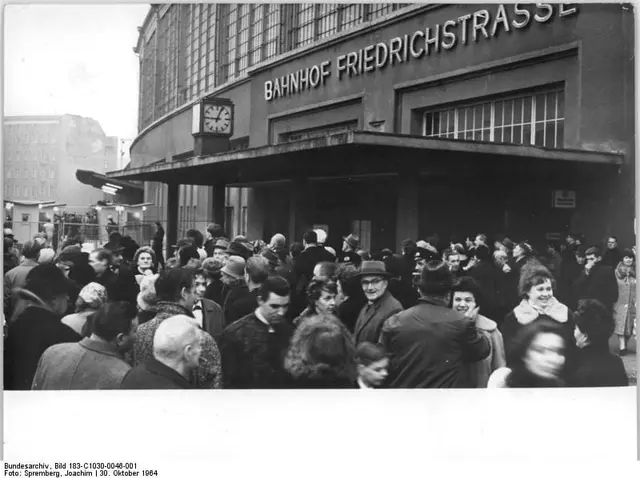
Jumping onto the Moscow–Paris Express behind Friedrichstraße
In January 1964 a group of young East Berliners jumped, alone or in pairs, from a hiding place just behind Friedrichstraße station onto the westbound Moscow–Paris Express. The route was discovered when Karl-Heinz Richter stumbled, was badly hurt and was arrested.
14 March 1964
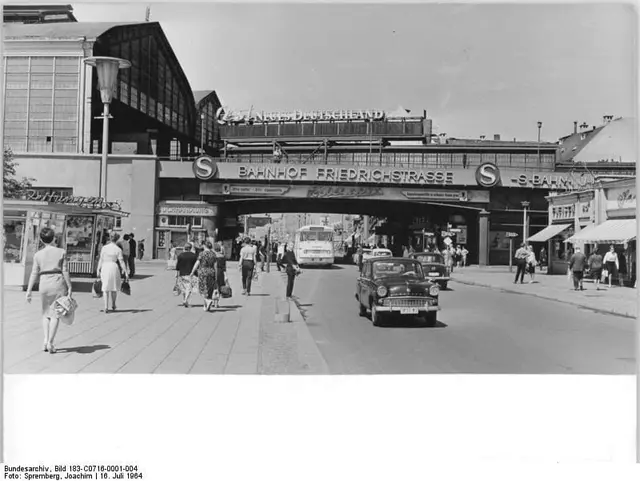
The wheelchair on the S-Bahn to Zoo
Two young men, one of them posing as a frail wheelchair user, cut the padlock off the lift to the westbound platform at Friedrichstraße and let the S-Bahn staff help them onto a train to Bahnhof Zoo.
16 May 1964
The borrowed identity card: a wife crosses on a stranger's papers
A man who had fled the GDR in 1963 took a West German apprentice from Holstein on a trip to East Berlin and kept her papers 'for safety'. Someone left through Friedrichstraße on them – according to the Stasi, his wife, who resembled her.
19 May 1964
A 'lost' Danish passport at Friedrichstraße
Fifteen minutes after someone had left East Berlin on her passport, a Danish woman turned up at the Friedrichstraße crossing to report that her papers had gone missing.
January 1965
Through a cut grille between the S-Bahn platforms
A young West Berliner who had fled himself the year before cut a grille beneath the glass wall between the S-Bahn platforms at Friedrichstraße so that his girlfriend could slip through.
10 January 1969
A kick through the glass wall at Friedrichstraße
Shortly after midnight a man kicked in a glass panel of the partition at Friedrichstraße station and got into the hall where the trains to West Berlin left, but he was arrested on the next westbound train.
24 July 1971
A Danish tour guide, a doctored passport and a 16-year-old from Rostock
A Copenhagen tour guide tried to take a 16-year-old from Rostock through the Friedrichstraße crossing on a doctored Danish passport and was caught in the act.
29 March 1974
Czesław Kukuczka: an exit visa, then a shot in the back at Friedrichstraße
A Polish fireman threatened to blow up the Polish embassy in East Berlin unless he was let through to West Berlin. He was given an exit visa and taken to the Friedrichstraße crossing by a Stasi officer, then shot in the back during the clearance procedure and bled to death in the Stasi prison hospital.
10 April 1976
Refugees in the boot of an embassy car: the Zaire attaché and the ARAMCO network
An administrative attaché of Zaire's embassy in East Berlin used his diplomatic car to drive at least eight East Germans to West Berlin in the boot. The operation ended when his courier was arrested at the Friedrichstraße crossing.
18 January 1979 – 19 January 1979
Stasi officer Werner Stiller walks out through the Friedrichstraße agents' gate
After breaking open safes at Stasi headquarters, First Lieutenant Werner Stiller of the foreign intelligence service used his service pass to get through the Stasi's own border gate at Friedrichstraße station and rode the U-Bahn into West Berlin.
27 May 1983
The S-Bahn hijacking at Friedrichstraße
A 24-year-old forced his way into an S-Bahn driver's cab with an air rifle and tried to make the train run on into West Berlin; it stopped short of a buffer stop and he was overpowered by officers of the passport control unit.